

The 5-hour train journey from Chennai to Mysuru (formerly Mysore) was pretty uneventful. We were travelling in executive class, a far cry from what I’d imagined Indian train travel would be like. We were attended to from the minute we sat down. First, the water and our choice of newspaper. Then the chai tea and biscuits. Then cornflakes. Then a veg or non-veg meal. All served quickly and efficiently. The seats reclined with plenty of space and all faced in the direction of travel.
I could get used to this.
Mysuru station is a much smaller, more easily navigated affair that the station at Chennai – it’s an impressive building, one of many in the city.
There’s a strong move in the county to reclaim the original, precolonial names of cities and towns and even roads and streets. Some debate the wisdom of this, as the names are part of the country’s history. Branded names, though, stay the same: Mysore silk, Mysore dosa, Mysore pak.
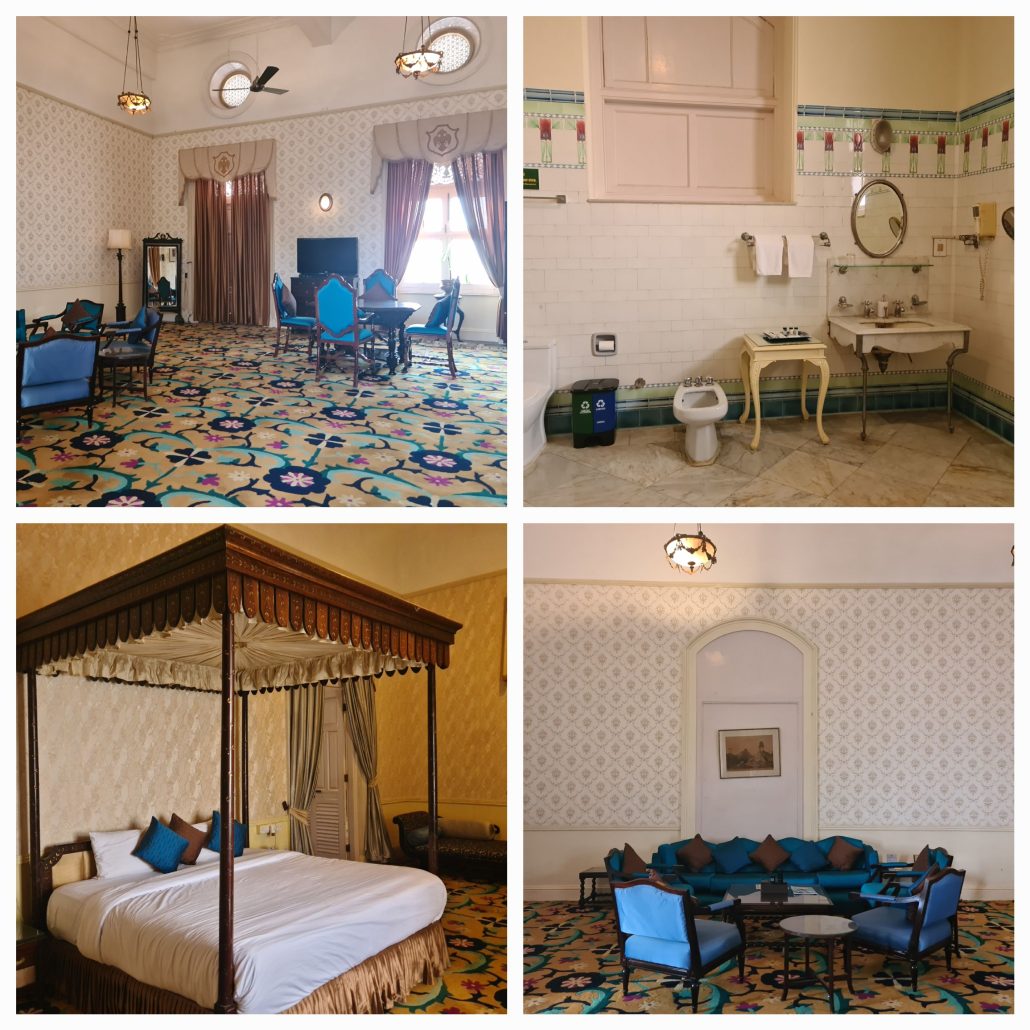
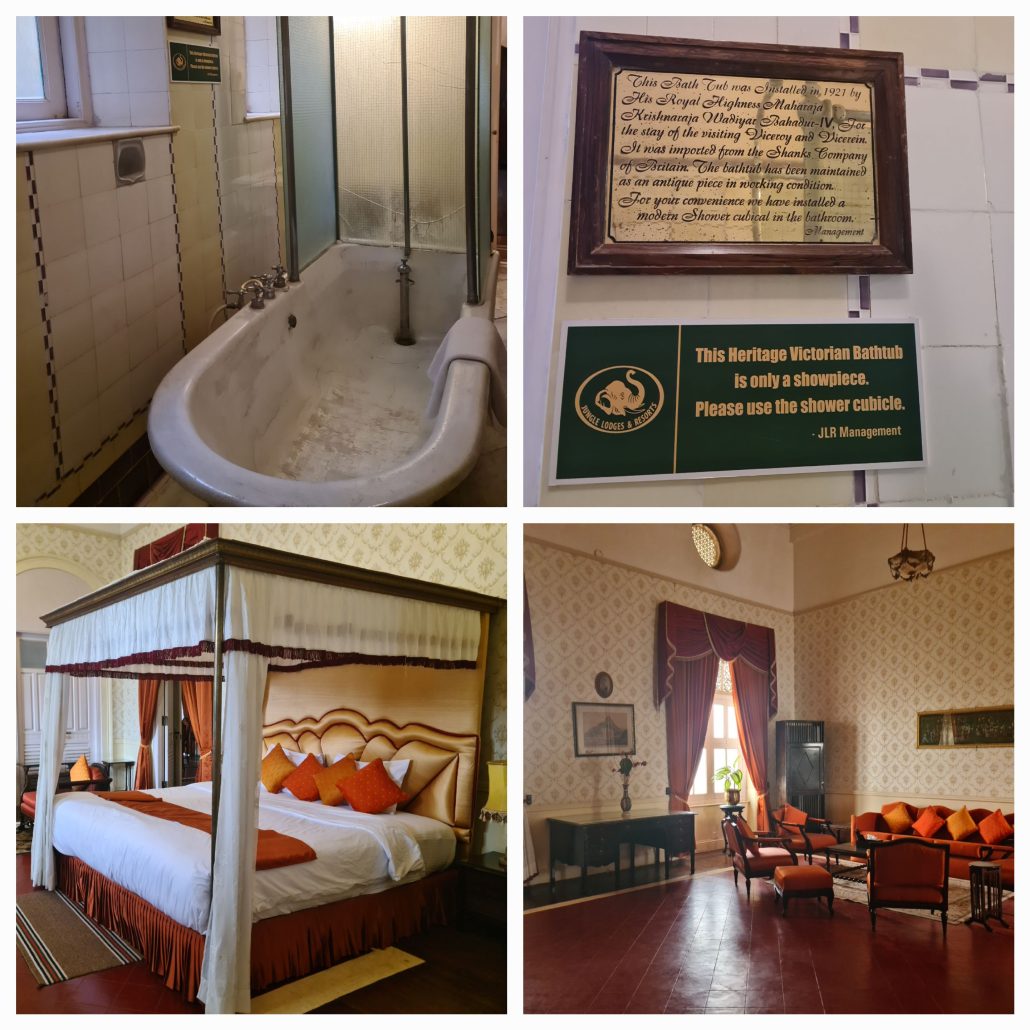
We ubered from the station and as we drove up to our hotel – the Lalitha Palace Hotel – were were a tad taken aback. I hadn’t realised it would be so, well, palatial. It was built by the Maharaja for his visiting guests. Even today, the Chief Minister stays in the Queen’s room (#222) when he’s in the city. We had a personal tour of the palace from Suhas, who would be our go-to-guy for information in the next few days.
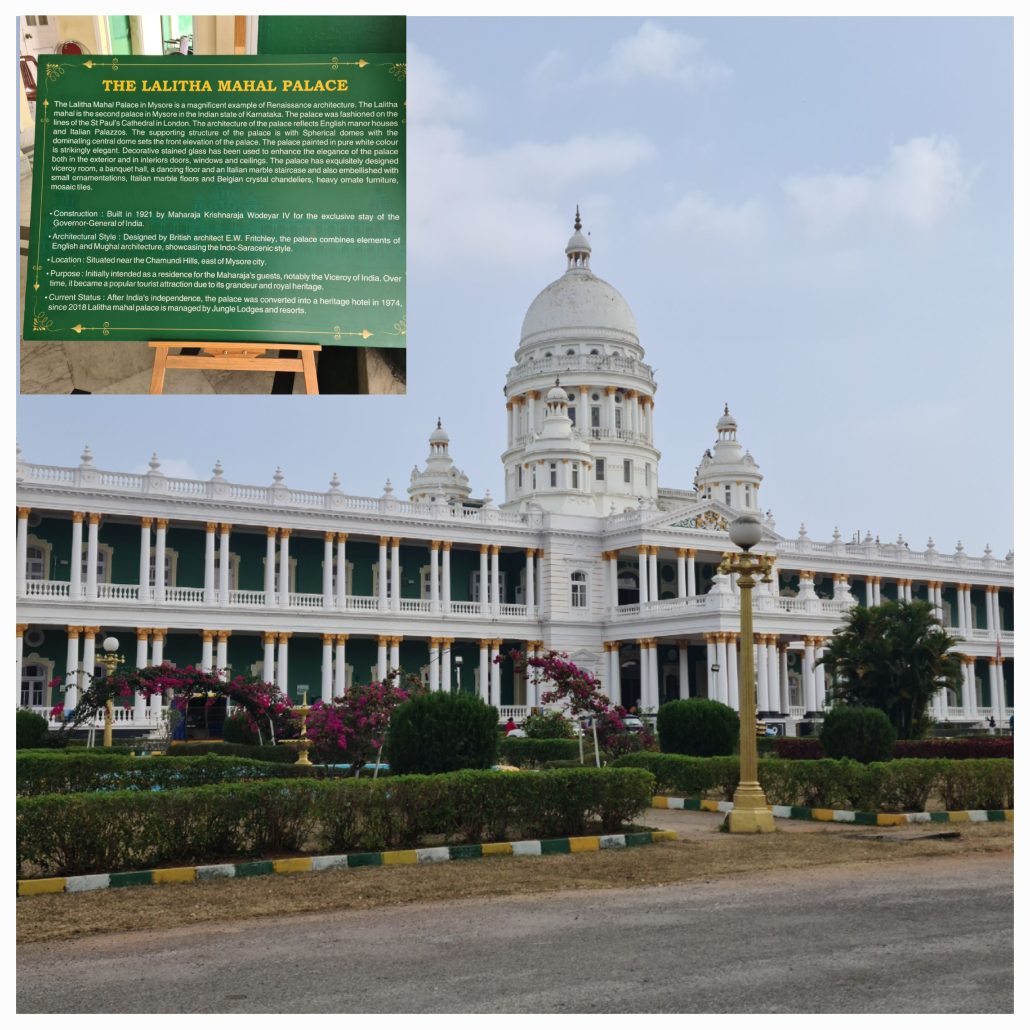
While at first glance, it’s an impressive place, there are definite signs of ageing. Its grandeur faded, it’s still a popular spot for day trippers who come to take selfies in the gardens or on the staircase. This flurry of poseurs effectively puts the swimming pool out of commission.
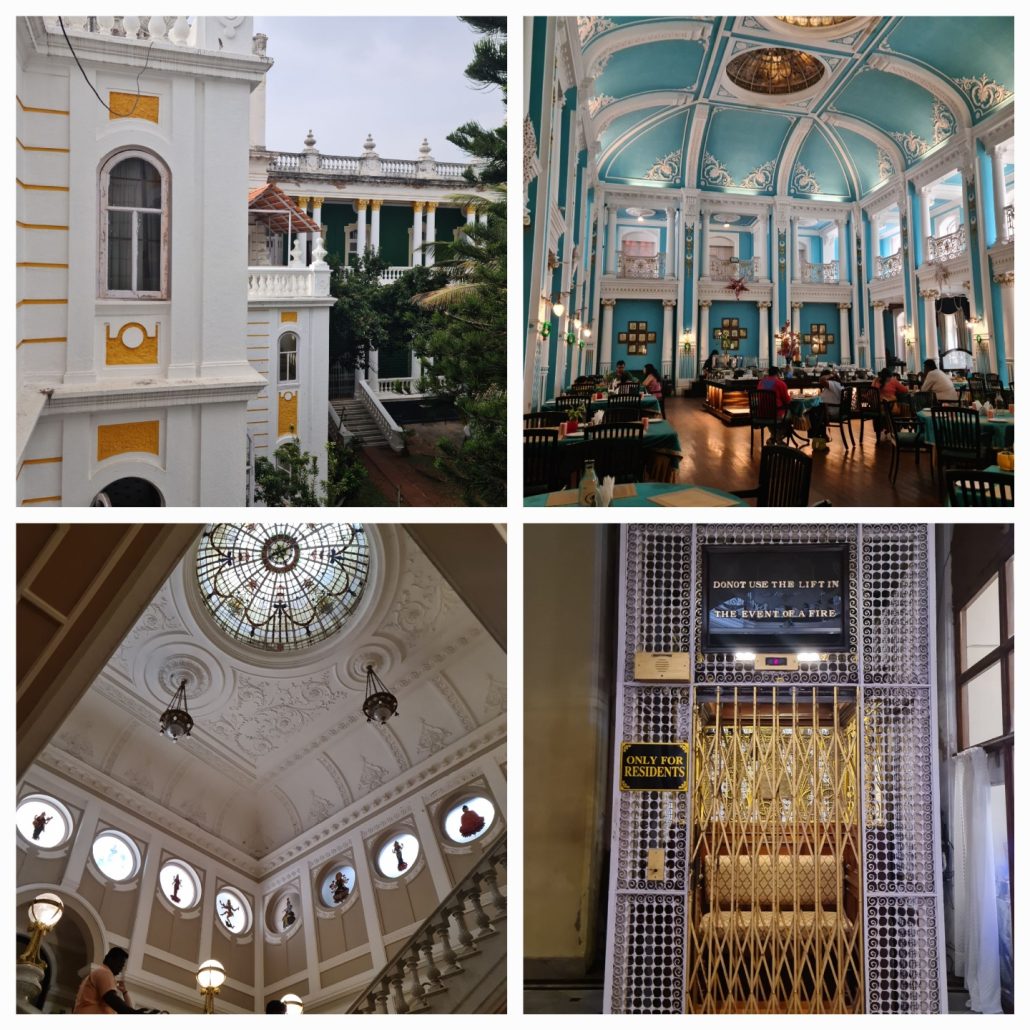
The dining room was one of two ballrooms and is still impressive. The two baths, imported from Shanks in England before the Viceroy and his wife came to visit, are still displayed in the King’s and Queen’s rooms. Marble came from Italy, glass from Czechoslovakia, lights from Belgium. It ticks all the multiculturalism boxes.
We’d booked a walking tour of the city for 4 pm, so again, we ubered into town, this time on a tuk-tuk. It’s a great way to get around, being both inexpensive and convenient. We were to meet our guide outside the Sri Jayachamarajendra Art Gallery but were early, so we went searching for a coffee. Plant milk is in short supply – it’s not quite caught on as yet, and coffee, filter coffee, comes with milk and sugar – definitely not to my taste. We ran into a Hungarian girl who used to summer near us in the village – married now in London to an Indian chap from Mumbai, they were here on holiday before emigrating to Canada. A small world indeed.
Faizan, our guide, like many young Indian lads, made his mam happy by training as an engineer. I’d hear this again and again – so many engineers who never work as engineers because they never wanted to be engineers in the first place. When he’s not making documentaries, he’s giving well-curated guided tours of his home city.
The art gallery displays a fraction of what the royal family owns. We spent a little too long there for my taste; I was itching to hit the streets and see the sights. But tribute must be paid. And, in fairness, the painting – the Lady with the Lamp, aka the Glow of Hope, with its fascinating backstory, was worth the admission.
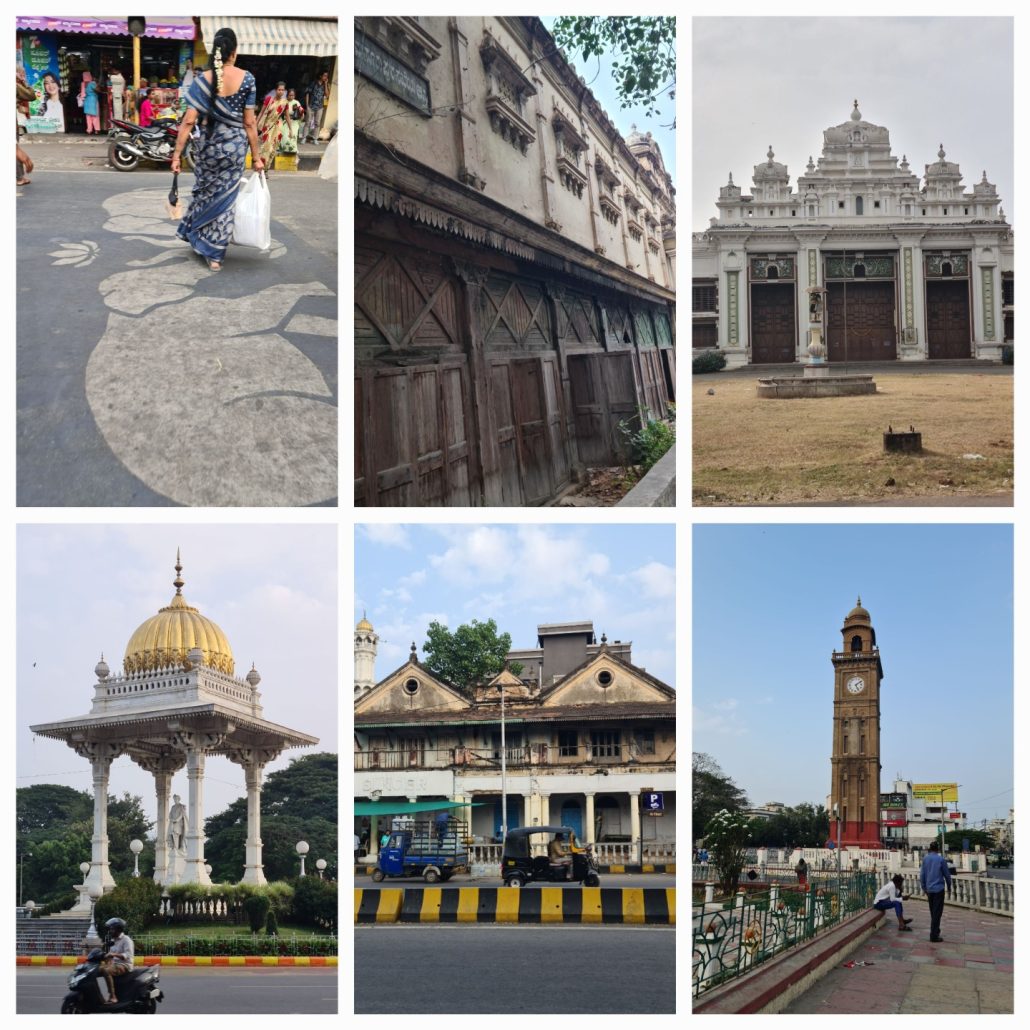
Finally outside, we wandered seemingly aimlessly, but there was a plan. We saw the clock tower, built in 1927, giving the nod to Christianity with its Roman windows, Hinduism with its floral-patterned stonework, and Islam with its dome. He pointed out a seeming error on the face, something I failed to notice – I pleaded exhaustion as I was now running on empty.The 4 is written as IIII and not as IV. The palace staff paid for it as a gift to Nalvadi Krishnaraja Wadiyar IV on the 25th anniversary of his rule. And I believe it’s wound manually every three days.
He pointed out where Sri K. Pattabhi Jois (1915-2009) developed Ashtanga yoga. His grandson became quite famous, teaching many celebrities, including Gwyneth Paltrow and Madonna. When he died suddenly while out hiking at the age of 52, his death rocked the yoga world.
We passed the Krishna Rajendra Circle, which is to Mysuru what the Connaught Circle is to Delhi. We crossed an elephant crossing, all the while marvelling at the random chaos on the roads and the seemingly rule-free traffic systems.
We saw the statue of Chamarajendra Wodeyar X, commissioned by his wife and sculpted by William Robert Colton. When it was unveiled, his wife wasn’t at all happy, saying it looked nothing like her husband. She had the head redone; today, the Indian head on the very Victorian body is an unwitting nod to the Anglo-Indian history and times past.
Faz pointed out the Singer building, the first building after the palace, once home to one of the oldest Freemason’s Lodges in the state. It predates the palace to the 1880s. With a membership that included some of the Wodeyar dynasty, this direct royal patronage was rare. As a meeting ground for British officials and Indian elites, the lodge symbolised Mysore’s openness to Western scientific, legal, and administrative ideas, while remaining culturally Indian.
The old Lansdowne Bazaar, from 1892, stands empty while the vendors occupy temporary stalls outside. It, too, is an impressive building, built by Maharaja Chamarajendra Wadiyar X to honour the visit of the Viceroy and Governor General of India Henry Petty-Fitzmaurice, the Marquess of Lansdowne. And why not?
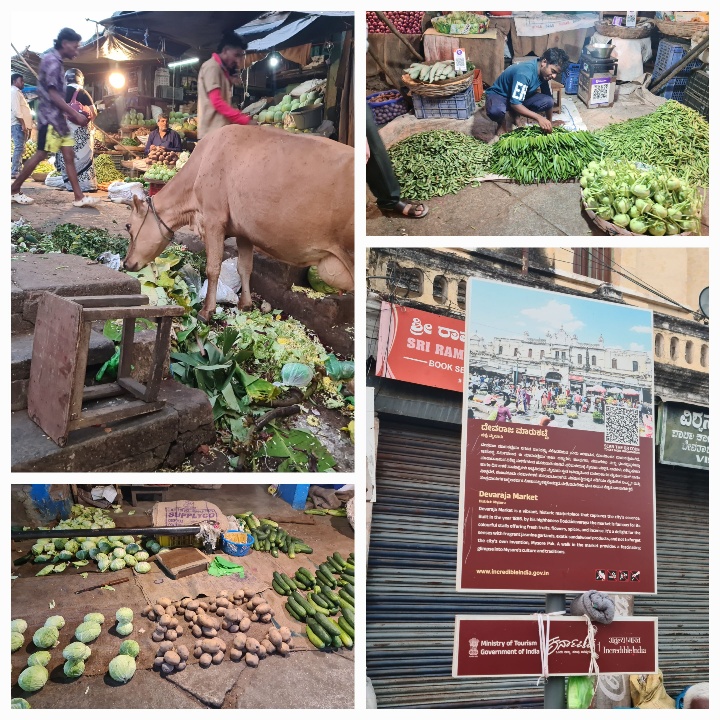
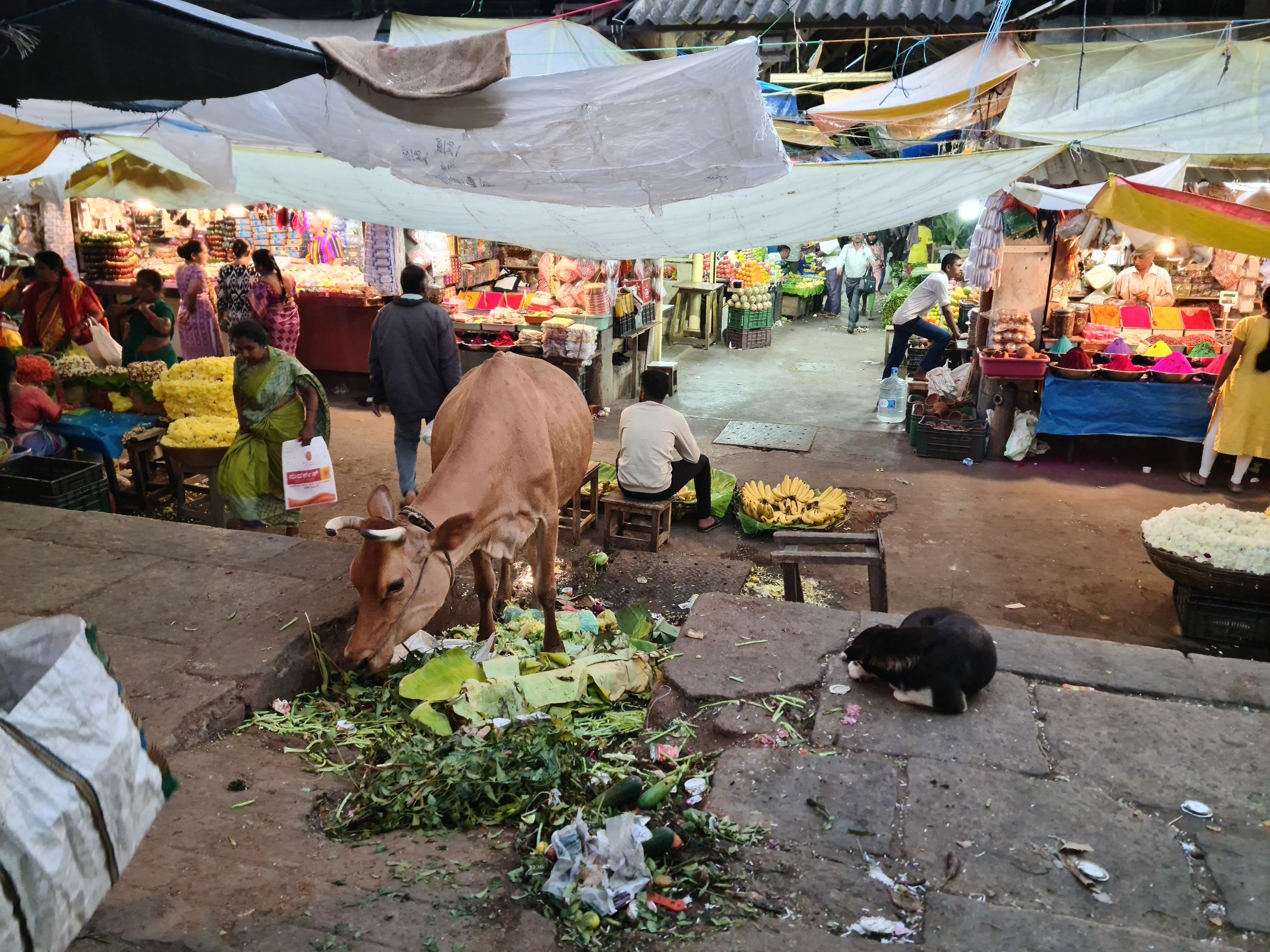
The highlight of our tour was the Devaraja market.
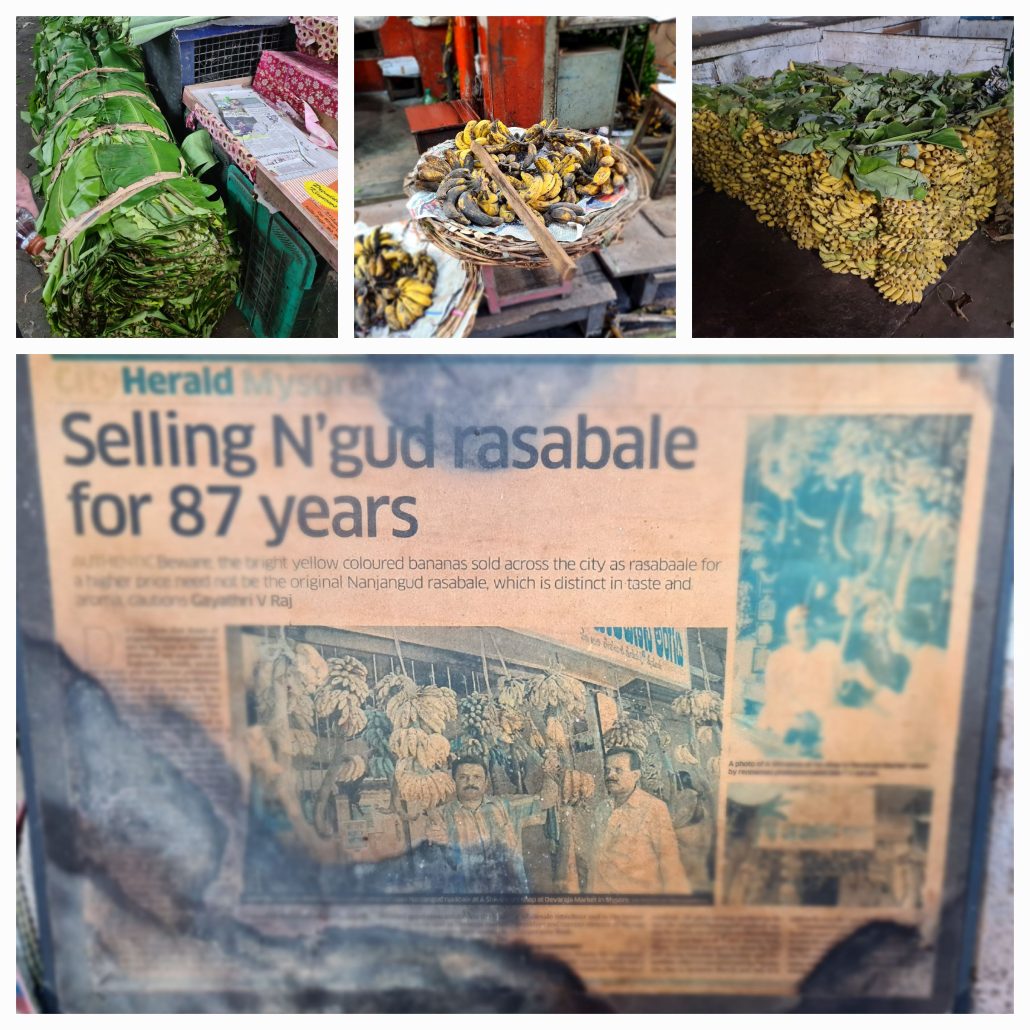
We met some strange bananas – GI-tagged Nanjangud bananas – locals call the banapple. These small fruit are ripened in dark, incense-filled rooms and taste remarkably like pineapples.
The flower sellers sat threading their leis, the place of cacophony of colour. Flowers are big here. Hair. Cars. Scooters. Tuk-tuks. Idols. Weddings. Funerals. Temple offerings. Flowers for every occasion. The hanging leis with the bulging middles were intriguing. The bulges are filled with corn husks, so when the leis are thrown away, the cows get to eat the rice and husks.
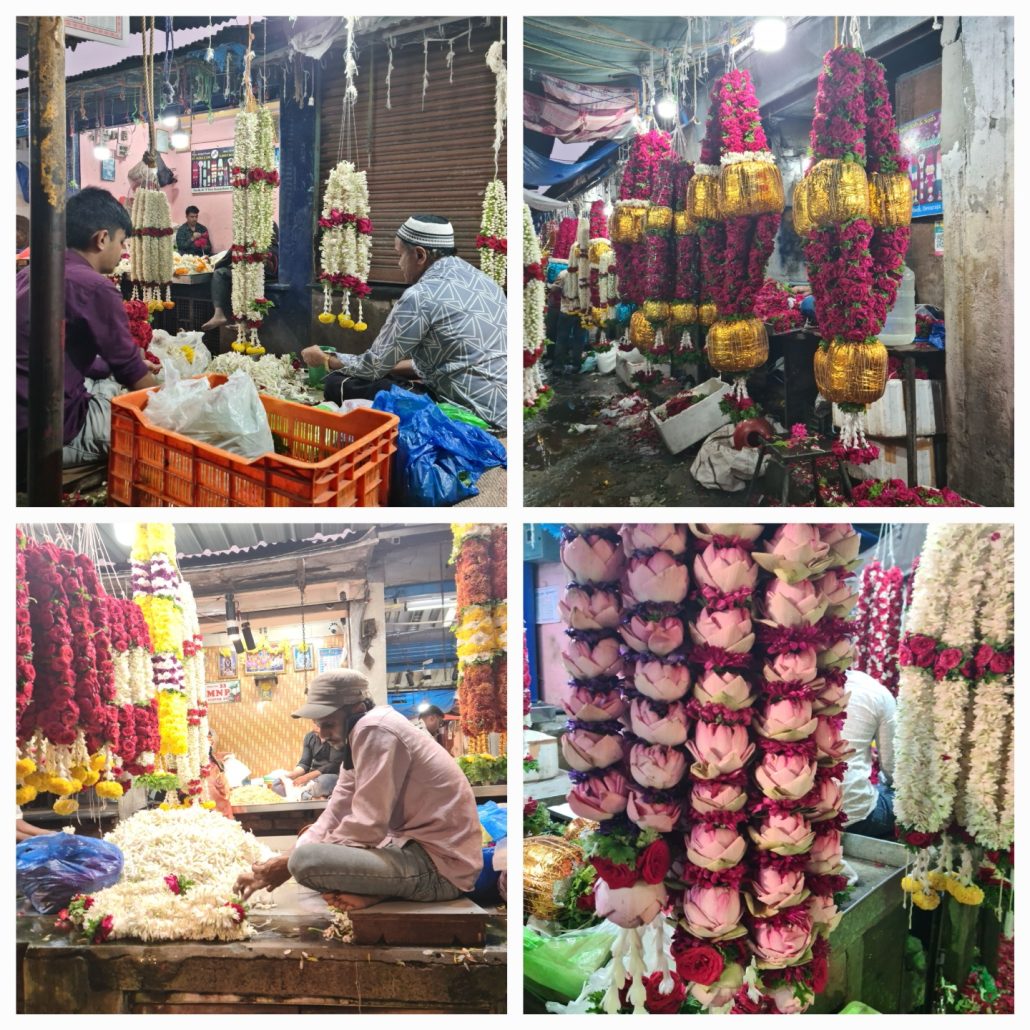
We passed through dollar alley – where each small, tidy heap of veg costs 20 rupees.
Along the way, Faz added spice to the history with random pieces of trivia. A young muslim by the name of Sake Dean Mahomen met a young Irish student in Cork in the late 18th century. They eloped and moved to England, where he introduced the precursor to what we know as shampoo. He was known as the Shampooing Surgeon of Brighton.
The word shampoo comes from the Hindi word chāmpo (चाँपो), meaning “to press, knead, or soothe,” derived from the Sanskrit chapayati, referring to massage, especially of the head and body with oils and herbs
And there was punch:
The word “punch” for the drink comes from the Sanskrit word panch (or pāñc), meaning “five,” referring to the traditional five key ingredients: alcohol, sugar, lemon/lime, water, and spices/tea, brought to England by the British East India Company in the 17th century.
He told us that is more to Indian movies than Bollywood.
- Kollywood (Tamil): Chennai-based, known for high-energy action and romance.
- Tollywood (Telugu): Based in Andhra Pradesh/Telangana, a powerhouse in recent box office revenue.
- Mollywood (Malayalam): Kerala-based, acclaimed for realistic storytelling and strong scripts.
- Sandalwood (Kannada): Karnataka’s industry, also a significant revenue generator.
- Pollywood (Punjabi): Produces Punjabi-language films, popular in North India.
- Dhollywood (Gujarati): Focuses on Gujarati-language cinema.
- Chhollywood (Chhattisgarhi): From Chhattisgarh, known for local stories.
- Bengali Cinema (Tollywood): Kolkata-based, historically significant, producing Bengali films.
He recommended the Great Indian Kitchen – it’s on my list. He also told us about Sabu Dastagir (1924-1963), the Indian actor who was once a stable boy for the Maharaja of Mysore. Discovered by filmmaker Robert Flaherty (who also made The Man of Aran about life on the Aran Islands in Ireland), Dastagir was cast in the film Elephant Boy (1937) and later in The Jungle Book and The Thief of Baghdad.
Before we finished up, he took us to taste some Mysore Pak, a dessert made for the Maharaja in 1935 and still being made by the same family four generations later, and sold from their shop, Guru Sweet Mart. A must-try, but way too sweet for me.
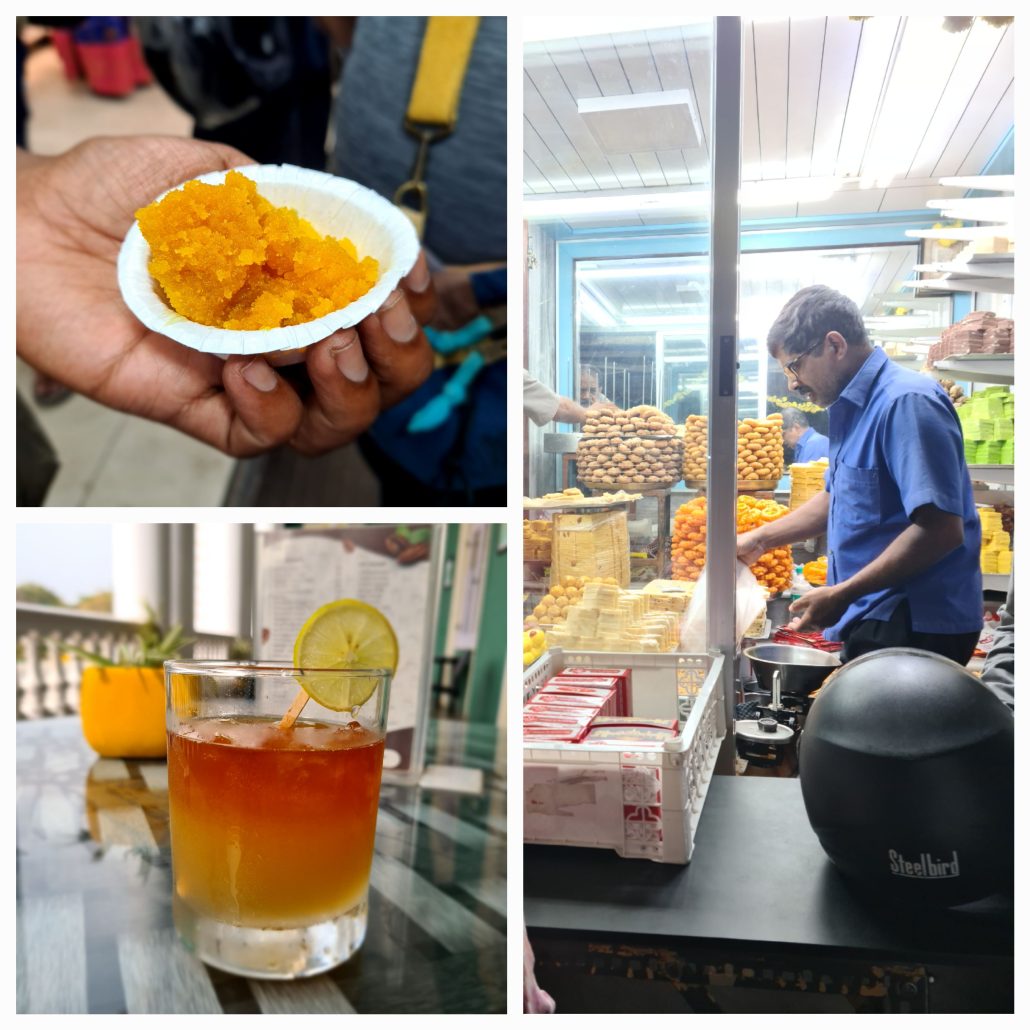
It was a wonderful introduction to the city. We now had a much better idea of where to go and what to see. We also had some good recommendations for coffee (Minimal) and the famous Mysuru Dosa (TKS Iyengars) and a UK Charities Trust Initiative, the Green Hotel (the former Princess’s palace).
We had big plans to find somewhere to eat in town, but the long flight and train journey and the early mornings and latent jet lag had caught up with us. I have to keep reminding myself that neither of us is as young as we used to be.
We ran into another cheerful chap, Deepak, another Engineer-degreed guide, and took his card for the next day – I could see a temple or two in our future.
Back at the hotel, we met the lovely Madhu.S in the bar, who mixed us what would become our nightly tipple – a Mysuru Magic – pineapple and dark rum.
Dinner was buffet style in the fabulous ballroom. While the food was grand, it wasn’t a patch on what we’d gotten used to in Chennai. Home cooking in India rules.

2 responses