


Modesty aside, I think I have a fairly decent vocabulary. I can’t lay claim to knowing every word in the dictionary but I could make an educated guess at the meaning of most. Yet I’d never heard of a charnel house. Char I could do, but charnel? In Naples, I visited a massive charnel house and didn’t even know I was in one until I’d left. Back in the day, when cemetery space was in short supply, it was common practice to bury bodies for a few years to let them decompose and then dig them up and move their bones to a charnel house where they’d take up far less room. In Fontanelle Cemetery, Naples, a 30 000 square metre cave in the hillside was once home to eight million of such bones. Today it’s thought that the remains of about 40 000 lie here but for the life of me, I can’t imagine how anyone could count.

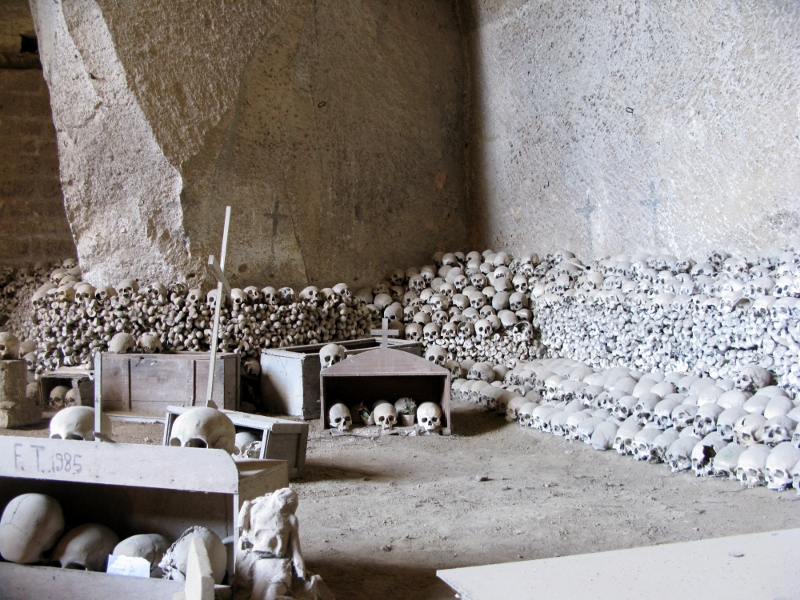
The original inhabitants had been relocated from cemeteries in the city in the sixteenth century to make room for those who insisted on being buried in their local church grounds – now there’s a different take on eviction. With the Great Plague of 1656, thousands more were added to the displaced. A century later, a great flood washed many of the bones out onto the streets (has a movie been made of it yet I wonder?). In the nineteenth century, Fontanelle Cemetery was officially named a pauper’s cemetery and its last big influx was provided by cholera victims of the 1837 epidemic.
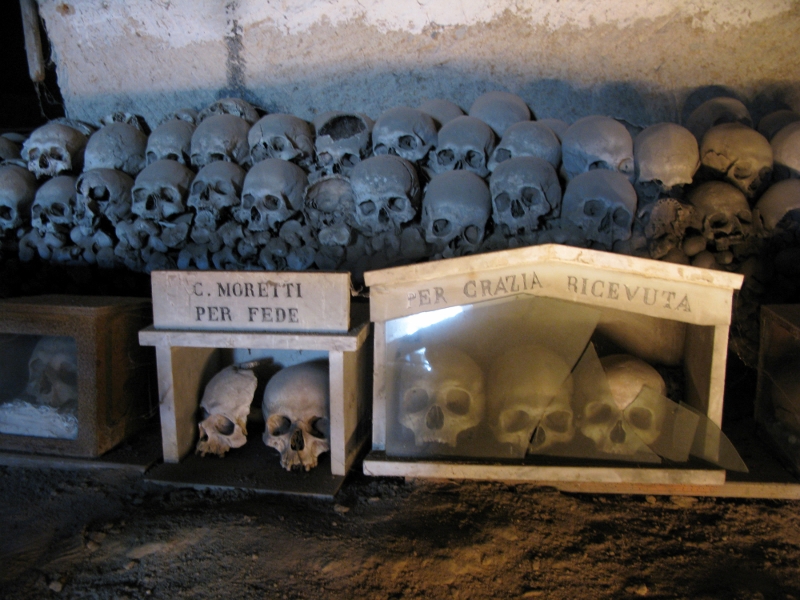


The bones are anonymous – rows and rows of skulls sit atop stacks of femurs and tibia, and stare back at you. I fancied I saw holes in some that suggested bullet wounds but it might well have been damage done in transit. It is one of the strangest places I’ve ever been – and I’ve been to a fair few cemeteries in my time.
Some have names carved into boxes but these may not match the bones inside. Apparently a cult took shape in the late 1800s when it was fashionable to adopt a skull and give it a name, a name that was often transmitted to the adopter through a dream. They would come to pray to their skulls and make offerings in the hope of having favours granted. The cult of the anime pezzentelle (abandoned souls) lasted into the late 1960s when the city’s Cardinal Ursi had enough. What might to those involved have seemed like caring for people in death who had no one to look after them in life, was branded a fetish and the cemetery was closed. It was renovated a few years ago and is now open to the public. Back by popular demand ….


It’s hard to find though, so if you’re in Naples and curious about Fontanelle Cemetery, take Line 1 metro to Materdei. Walk down the hill and around the corner to the left. Half-way along that street there are steps going down even more. Take these to the bottom and turn left. When you get to the small piazza, hang left and the cave is just past the church (worth a visit – a lovely change from the ostentation of the bigger city churches) on your left. Free entry. Open 9-4pm.



2 responses
Macabre, but not that uncommon in other parts of Europe.