

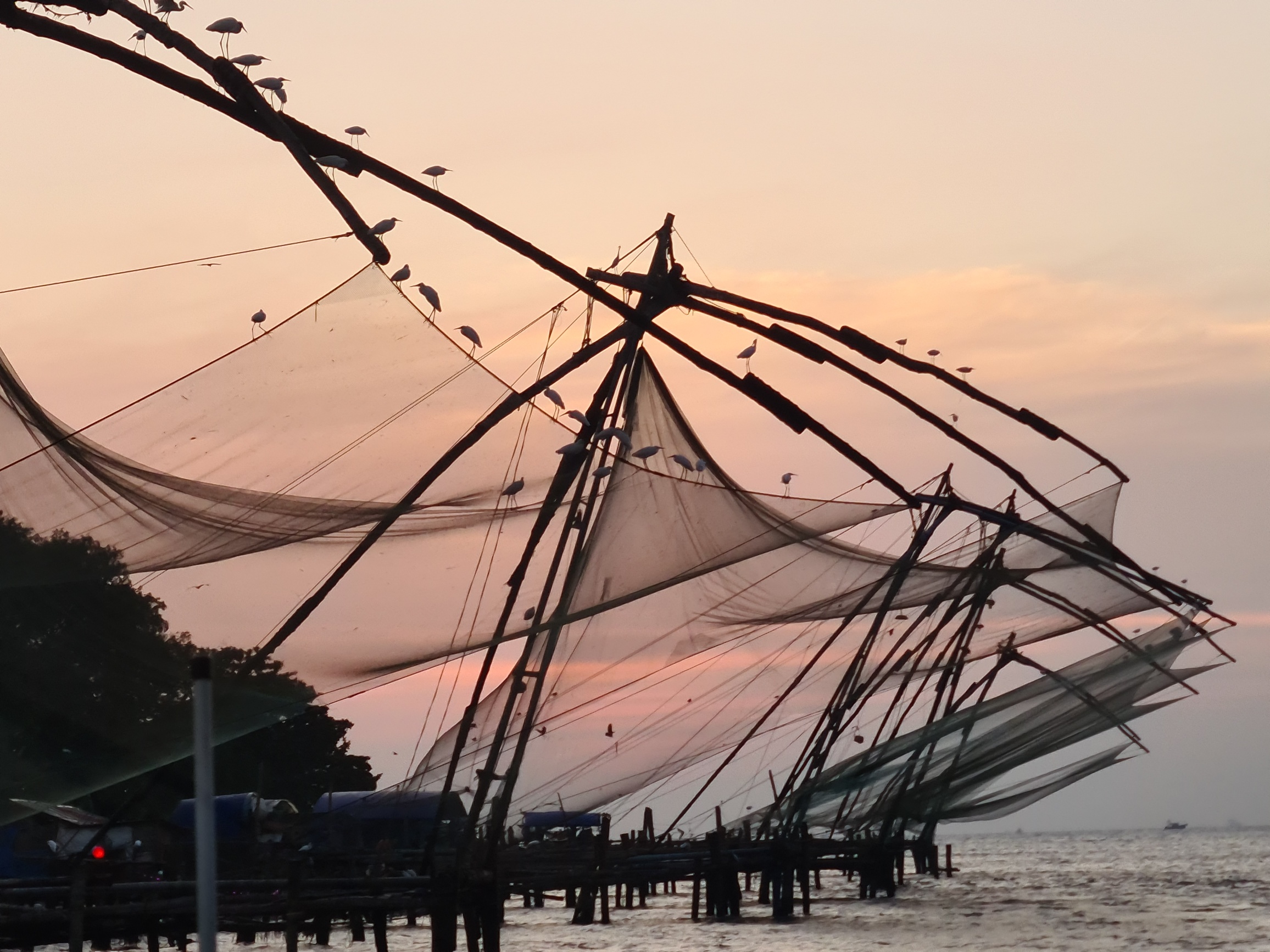
When we left Munnar, we headed towards the coast to the city of Kochi (formerly Cochin).
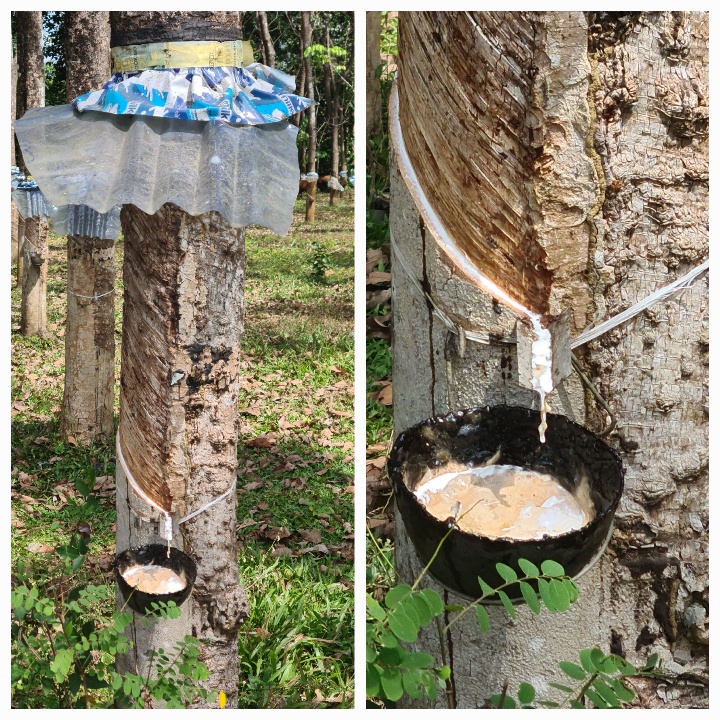
On our way, we passed through the rubber plantations around Kothamangalam.
India is the world’s fourth-largest consumer of natural rubber and fifth-largest of combined natural and synthetic rubber, so it makes sense to produce what you can at home.
Little did I know at the time that one John Joseph Murphy, an Irish agricultural entrepreneur, established India’s first commercially viable rubber plantation in Kerala in 1902. He’d go on to be known as the Father of Indian Rubber.
Known locally as “Murphy Sayipp,” he became a beloved figure, establishing schools, churches, and hospitals, and remained in Kerala even after India’s independence, choosing to be buried with his workers.
On a rainy day in Ooty, South India’s famous hill station, some nuns were walking along a road in the cold. Suddenly, a car stopped by and the gentleman driving it offered them a lift. He asked why they were not using a vehicle in such inclement weather. The nuns replied that their convent did not have one. The next day, a local dealer delivered a brand new Dodge car to the convent. The astonished nuns thanked the donor. They also told him they could not keep the vehicle because there was no money to engage a driver or to buy petrol. The gentleman assigned a driver on his payroll to the convent. He also instructed a petrol bunk to forward the convent’s bills to his office.
Am sure if we went back far enough, we’d find we were related.
We were staying in Fort Kochi, the much-trafficked part of town that is a magnet for tourists. Backpackers and retirees walked the streets, some there for the kicks, others for the yoga, more still for the Ayuvedic treatments.
We’d opted for a home stay rather than a hotel because we wanted to be in the thick of it. For a change.
Elza’s Fort Inn was as central as it gets. Our lovely host, Sangeetha, sent me a WhatsApp message noting the highlights, which was as good a guide as any.
As we wandered and happened upon them, I mentally ticked them off the list.
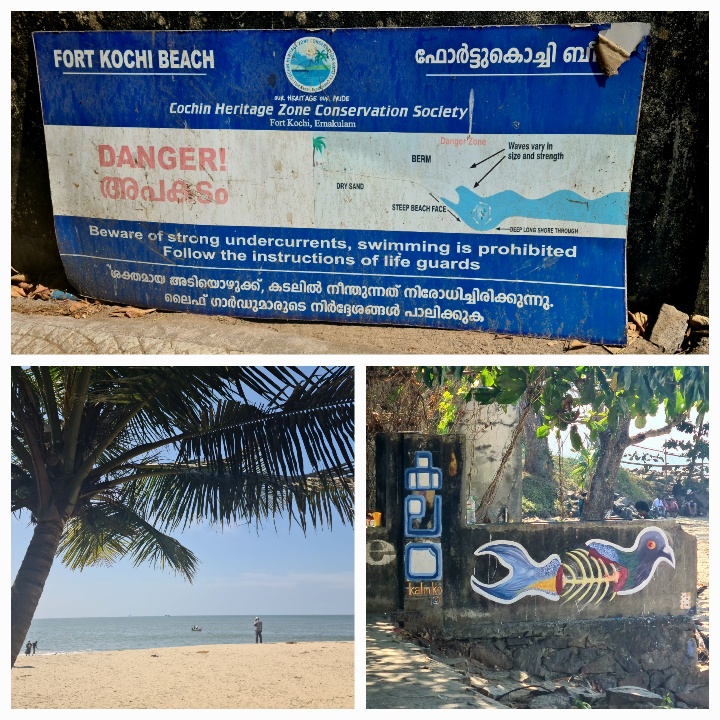
Excited to be by the coast, I was disappointed yet again that there was no swimming. The beaches fall off steeply; you could go from feet in the water to over your head in a split second. Still, it was great to get the sea air and smell the fish.
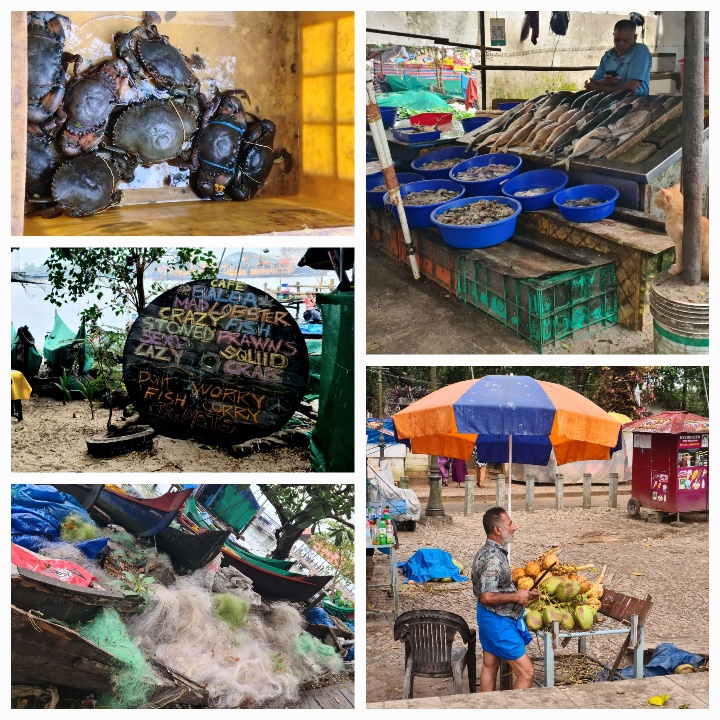
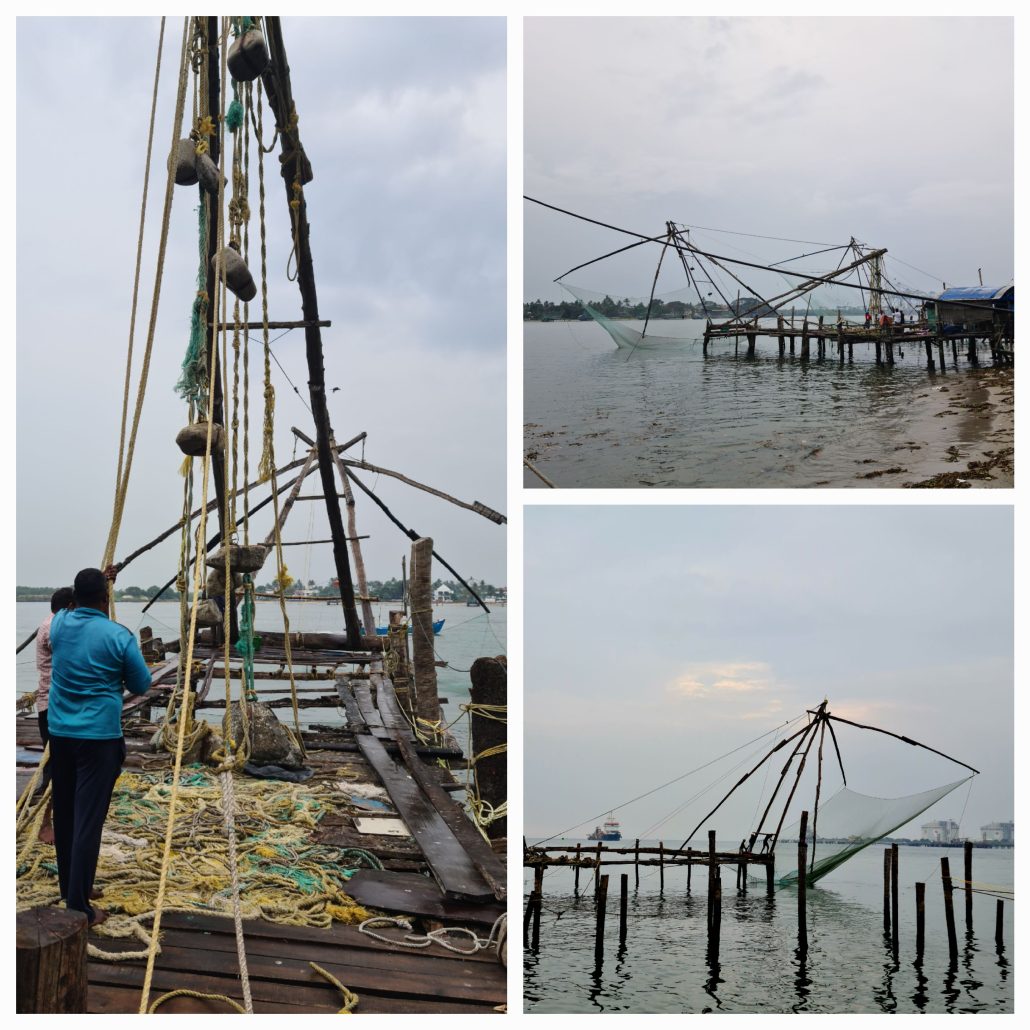
One of the main attractions in Kochi are the Chinese fishing nets.
Operated from the shore, these nets are set up on bamboo and teak poles and held horizontally by a huge wooden roller that acts as the pivot for the huge net and counter-weighted by huge stones hung on ropes. The counterweight is always lower than the forward weight of the entire forward structure. Once the net is dipped in the water for between 10-15 minutes it is then pulled up, by usually four men, pulling down the four ropes tied to the apex of the pivot. This is an energy-sapping exercise by men, lean and sun-dried, muscles ripped as ropes, bunched to define every muscle. These four-man crew for each net drew the nets at least 80-90 times during the incoming tides.
I can’t figure out how to load a video I took, but if you’re interested, ping me, and I’ll send it on.
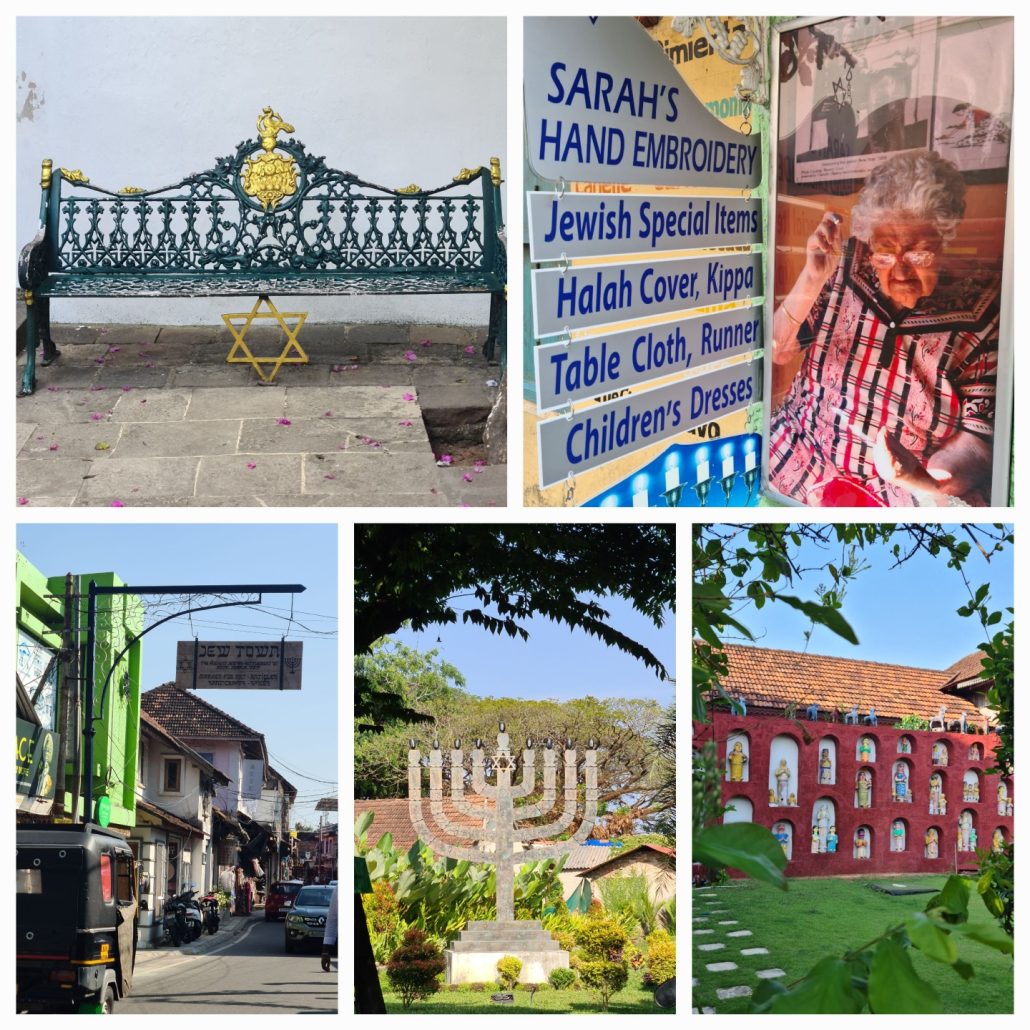
Another spot high on my list to see was Jew Town. It was here in 1524, that Jews from Kodungallore were sheltered by the King, who gave them land in Mattancherry. Today, it’s a bustling hive of activity with lots of antique shops and plenty by way of crafts.
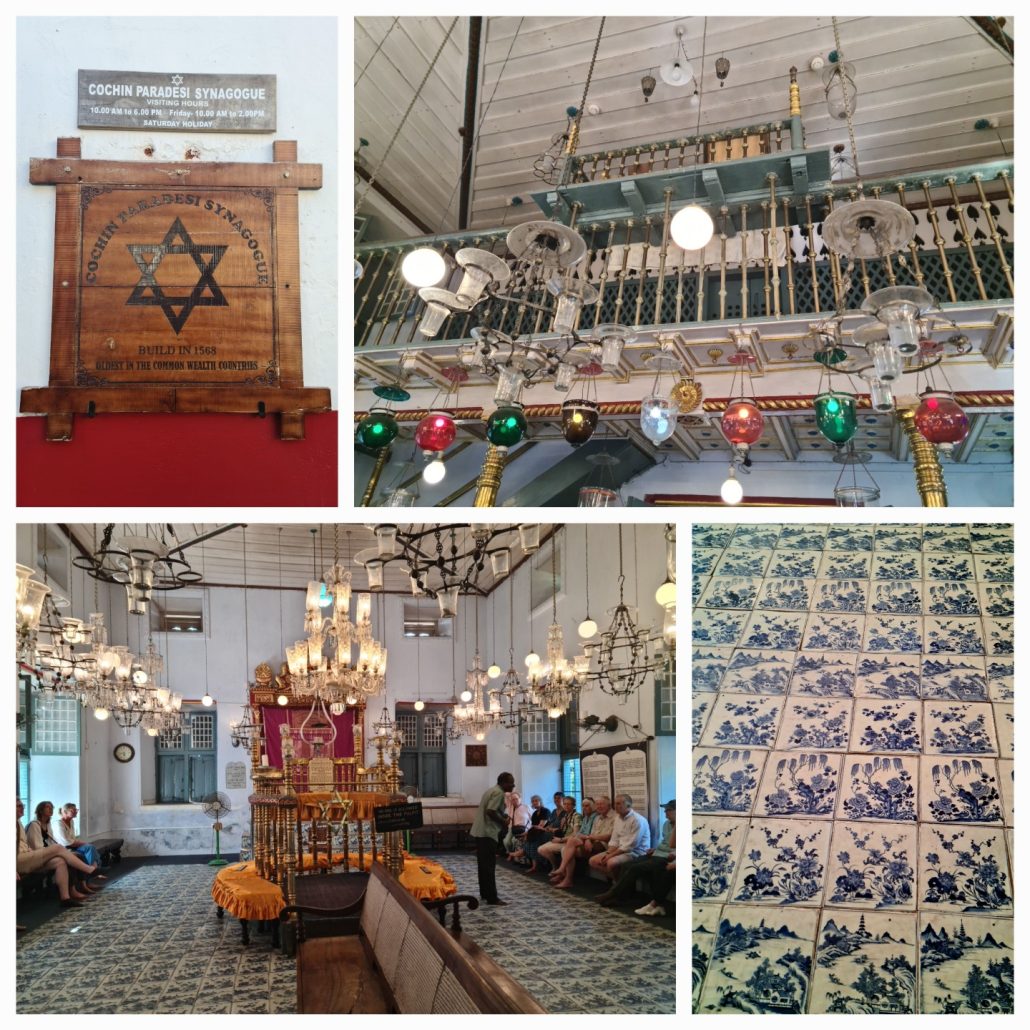
It’s also home to the Paradesi Synagogue, built in 1568, the oldest in the commonwealth.
There were once three types of Jews in Cochin. The Cochin Jews were one of the oldest groups in India; they traced their family tree back to King Solomon and were first mentioned in Southern India in the 12th century.
Later, in the 16th century, the Sephardi Jews arrived, having been kicked out of Spain. They became known as the Paradesi (foreign) Jews.
Later again, towards the end of the 19th century, a few Arabic-speaking Jews, known as Baghdadis, arrived from the Near East.
After India became independent, most of the Jews emigrated, the Cochin Jews heading for Israel and the Paradesi to Australia and other Commonwealth countries. Today, there are about 26 left in the area.
The 18th-century porcelain-tiled floor of the synagogue is amazing. Imported from Canton, China, no two are the same. They’re dyed with natural vegetable dyes and number 1,100 in all. When Queen Elizabeth II visited in 1997, she is said to have commented: It’s wicked to walk on them.
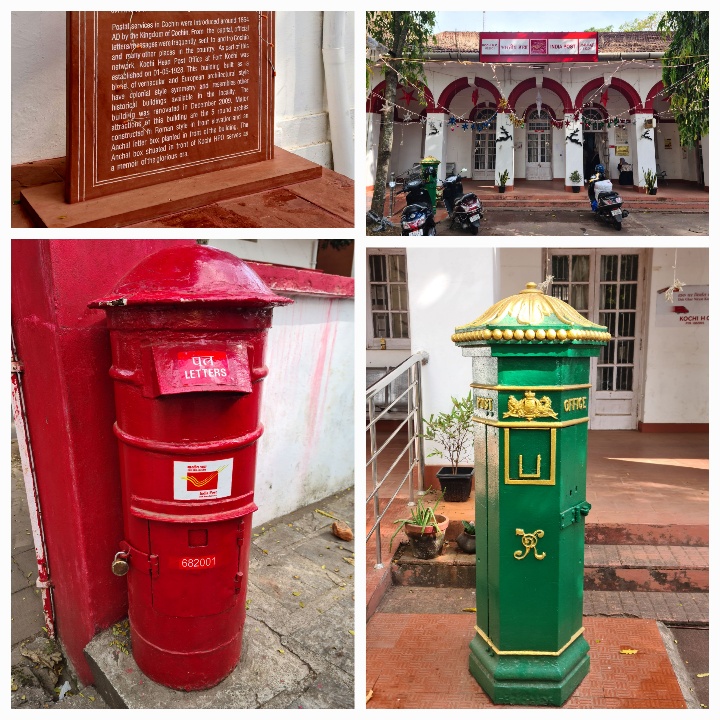
We also stopped by the old Post Office. Since Denmark stopped letter post from 1 January 2026, I’ve a new appreciation for an institution I’ve always taken for granted. Joseph Martin writes a nostalgic account of the PO in a post on Facebook – it’s worth a read.
I remember my father once telling me that during the Quit India Movement, the Fort Cochin Post Office became a silent theatre of resistance. Messages smuggled in beneath innocuous postcards, coded letters written in lemon juice, and British officers watching every move. Yet, for the common man, it remained the lifeline to loved ones across the seas and states.
There is no shortage of churches in Fort Kochi. Two stand out: The Santa Cruz Basilica and
In 1505, Dom Francisco de Almeida the first Portuguese Viceroy got permission from the Cochin Raja to build a church edifice using stones and mortar which was unheard of at that time as the local prejudices were against such a structure for any purpose other than a royal palace or a temple. The foundation stone of the Santa Cruz church was laid on May 3, 1505, the feast day of the ‘Invention of the Holy Cross’, hence the magnificent edifice when completed was named Santa Cruz.
It was raised to a Cathedral in 1558 and to a Basilica in 1984. A cathedral is the main church of a diocese and houses the Bishop’s chair, the cathedra. A basilica is an honorary title bestowed by a pope on churches with historical/spiritual significance. All four major basilicas are in Rome; the rest around the world are minor basilicas.
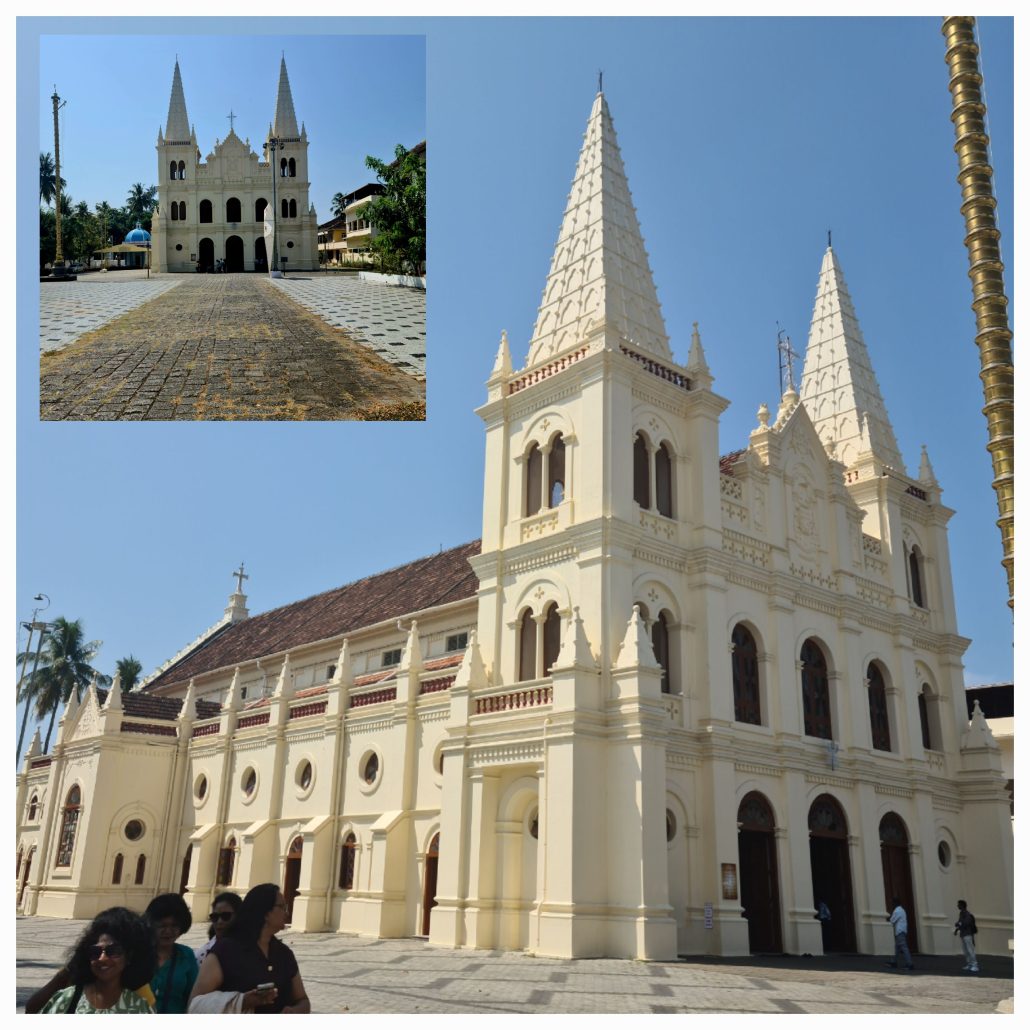
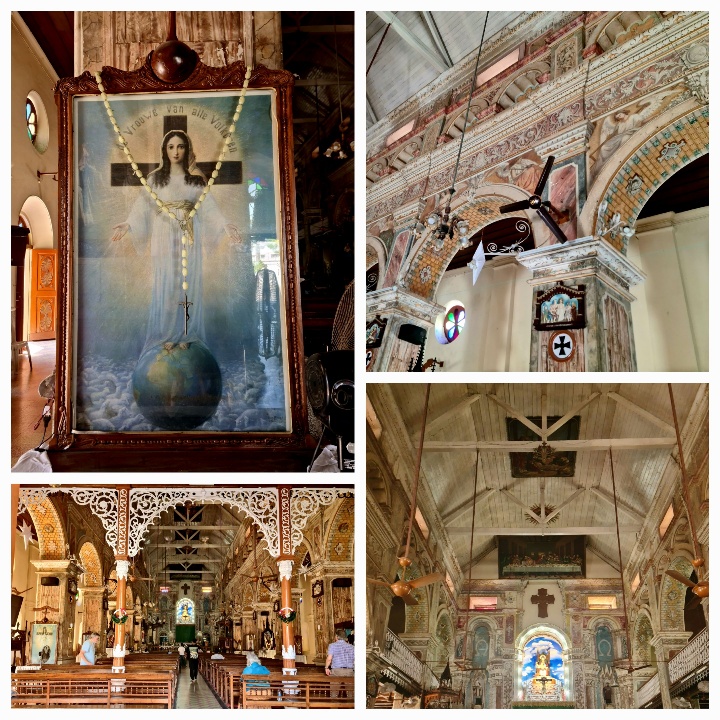
It was here that I first saw a picture of Our Lady of All Nations, around which there was no end of debate in Amsterdam, where, in 1945, Ida Peerdeman claimed to have seen Our Lady, who, she said, introduced herself as Lady of All Nations. Peerdeman went on to claim 55 more interactions up until 1959. The Vatican, it seems, didn’t agree.
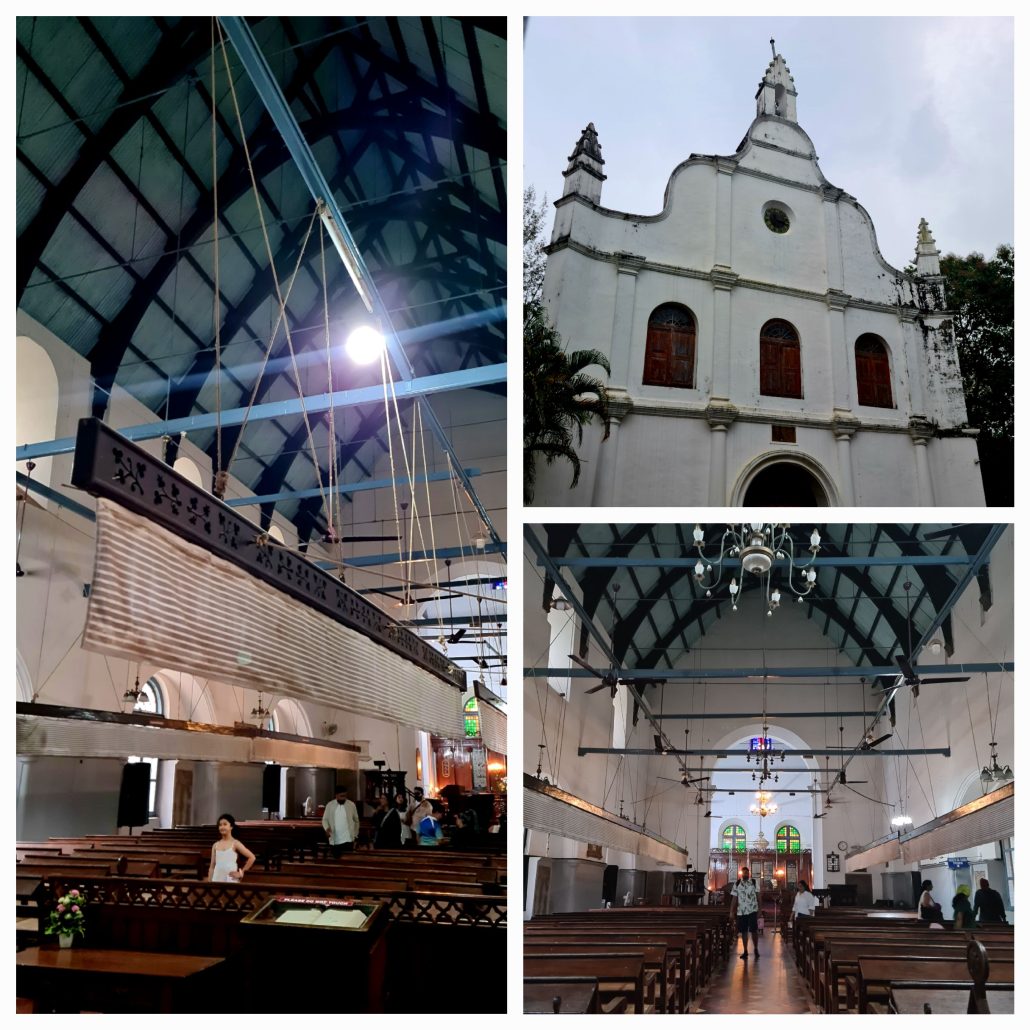
Second on our list was the Church of St Francis, one of the oldest European churches in India. It was here that Portuguese explorer Vasco da Gama was buried after he died here in 1524 on his third visit to India. Some 14 years later, his remains would be disinterred and taken back to Lisbon, where he now lies in Jerónimos Monastery. I was intrigued by the sail-like fans that were hand cranked to keep the congregation cool before the not-nearly-so-nice electric fans were installed.
Apart from the Sri Jayachamarajendra Art Gallery in Mysuru, the India Music Experience and the National Gallery of Modern Art in Bengaluru, museum visits have given way to palaces and temples. There’s a limit to what I can take in.
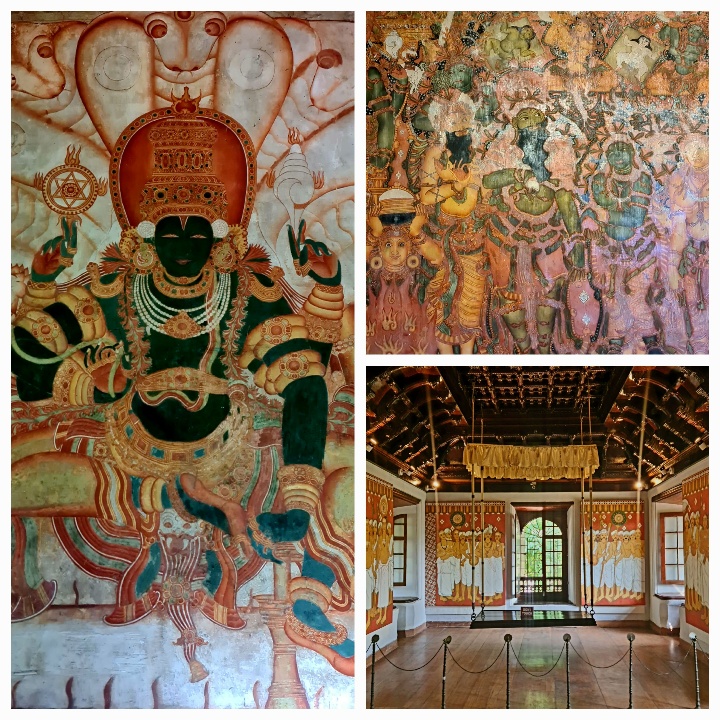
In Fort Kochi, though, we did visit the Mattancherry Palace Museum (aka the Dutch palace), built in 1555 and presented to Veera Kerala Varma I, he who resisted Portuguese expansion in the area, as an apology for the Portuguese having plundered a nearby temple. With mural paintings covering some 300 sq m, it is mindblowing in its detail.
Where to eat and stay in Fort Kochi
We found a lovely coffee shop – Café Le Te – that had plant-based milk and good breakfasts, and a great restaurant – Fusion Bay – that is still using recipes from the 17th century. They open for dinner at 6.30 pm. If you’re not there then, be prepared to wait in line or better still, make a reservation.
Homestay is the way to go if you want to be central in Fort Kochi. Elza’s Fort Inn is centrally located, offering clean, spacious rooms with A/C, and a very informative host.
A note on Ayurveda in Fort Kochi
Having tried and failed to get an Ayurvedic consultation in Munnar, I had high hopes for Kochi.
Ayurveda is a whole-body (holistic) system of medicine that began in India more than 3,000 years ago. Ayurveda is based on the idea that each person has certain life forces (doshas) and everything in the universe is connected. An imbalance in 1 area can affect another. When the imbalance is not fixed, disease and illness can occur. Ayurveda mostly uses nutrition, lifestyle changes, and natural treatments. These are used to support balance and a return to health. Ayurveda is very focused on overall health. But it may use specific treatments for some diseases.
I asked for a recommendation from the homestay and didn’t check further. My bad. The consultation was detached. Yet again, I didn’t feel that the doctor was fully present. I did ask how much the treatment would cost, but was only told about the consultation (half-hour 800 INR, about €8, considerably cheaper than in Budapest), and I didn’t press further. Silly of me, I know.
My treatment lasted almost two hours and was on par with what I’ve had in Budapest with practitioners from Kerala. And it was more expensive. That I wasn’t expecting. Himself had paid 1500 INR in Mysuru; mine cost four times that.
That said, it worked. The pain I’d been feeling went away.
My advice: Shop around. Check the reviews.
I had checked the reviews; they swung from awful to wonderful. Different strokes for different folks and all that.
I’m learning. Slowly. But I’m learning.
So far, Fort Kochi is where himself could see himself living. But with the air quality classified as unhealthy, I’m not convinced.
It is a great place to visit, though, somewhere to spend more time than we had.
Next, it’s across the water to see what else Kochi has to offer outside this vibrant neighbourhood.

3 responses
Your blogs are always interesting
With this detailed vision, I finally got beyond the awe and beauty of India to appreciate the information in the zoomed-in tour. It has left me with a list of things to research. The photo of the rubber trees may be worth a thousand words, but now I’m looking for more. Thanks for this journey. It’s much more than a visit.