
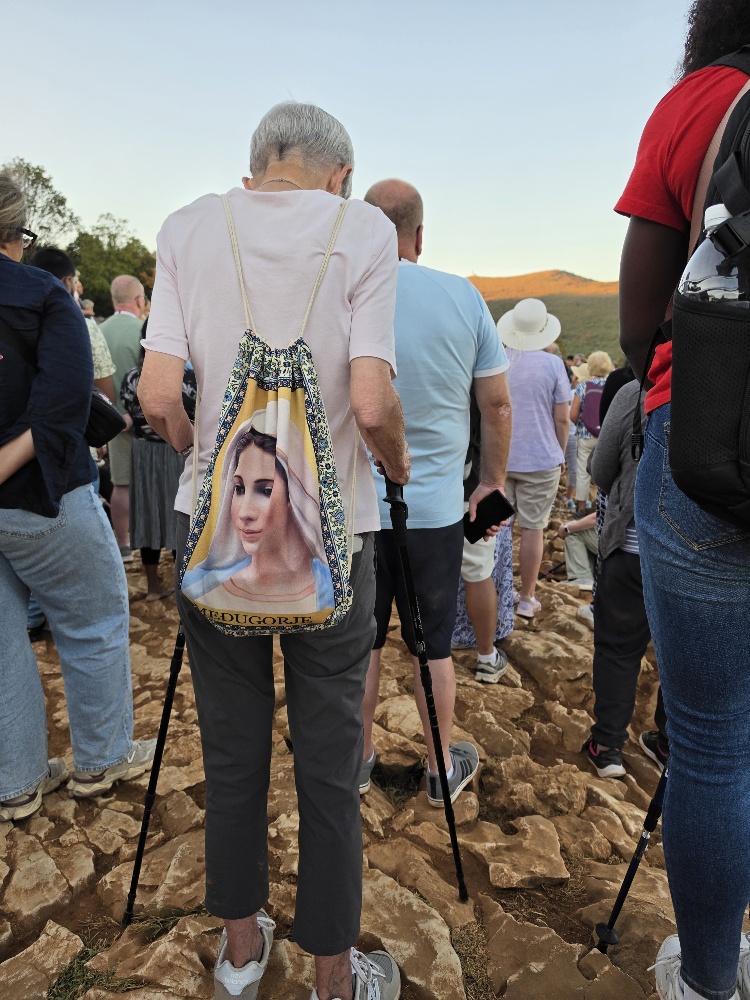
In 1981, something happened in the village of Medjugorje that would change the shape of things to come.
Dramatically.
Our Lady appeared to six young people and, in the course of the next few years, would begin to share ten secrets with each of them – hidden future events and warnings of what’s to come.
Mirjana Dragićević-Soldo: Received her 10th secret in 1982. She now receives an annual apparition on March 18th (her birthday).
Ivanka Ivanković-Elez: Received her 10th secret in 1985. She receives her annual apparition on June 25th (the anniversary of the apparitions).
Jakov Čolo: Received his 10th secret in 1998. He receives his annual apparition on Christmas Day.
Three others have received nine of the ten secrets: Vicka Ivanković-Mijatović, Ivan Dragićević, and Marija Pavlović-Lunetti. In addition to daily apparitions, Marija receives a public message on the 25th of each month, which is immediately translated into English, Italian, German, Spanish, French, and Polish and published.
When the time comes, visionary Mirjana Dragičević will share the details of a secret with a chosen Franciscan priest, Father Petar Ljubičić. Ten days before an event occurs, Mirjana and the priest will pray and fast for seven days. Three days before the event takes place, Father Petar will publicly announce what and where it will be to the world.
I had no idea.
I’ve been to Fatima and Knock (two of the six Marian apparition sites officially approved and endorsed by the Holy See). I hadn’t realised that the list of apparitions is as extensive as it is. Some have been approved locally by the Bishop, like Our Lady of Kibeho in Rwanda. Madonna of the Miracle in Rome is classed as an ‘approved contemporaneous miracle’, while Our Lady of Medjugorje has been approved for public veneration.
There are cases in which the Holy See or a local ordinary chooses not to open or definitively conclude an investigation into the supernatural character of the apparitions themselves, but approves of the public religious activity inspired by the apparition.
Regardless of how official it is, Medjugorje attracts between one and two million visitors each year, about the same as Knock. Of those, some 20,000 are Irish.
The Irishness is everywhere. The tricolour pops up in the most unusual places – a hairdresser’s, a pastry shop, and a hotel (The Medjugorje Irish Centre). Irish name bracelets have their own section on the stands. Northern Irish accents were quite common, and there’s even a chap from Derry buried in the local cemetery.
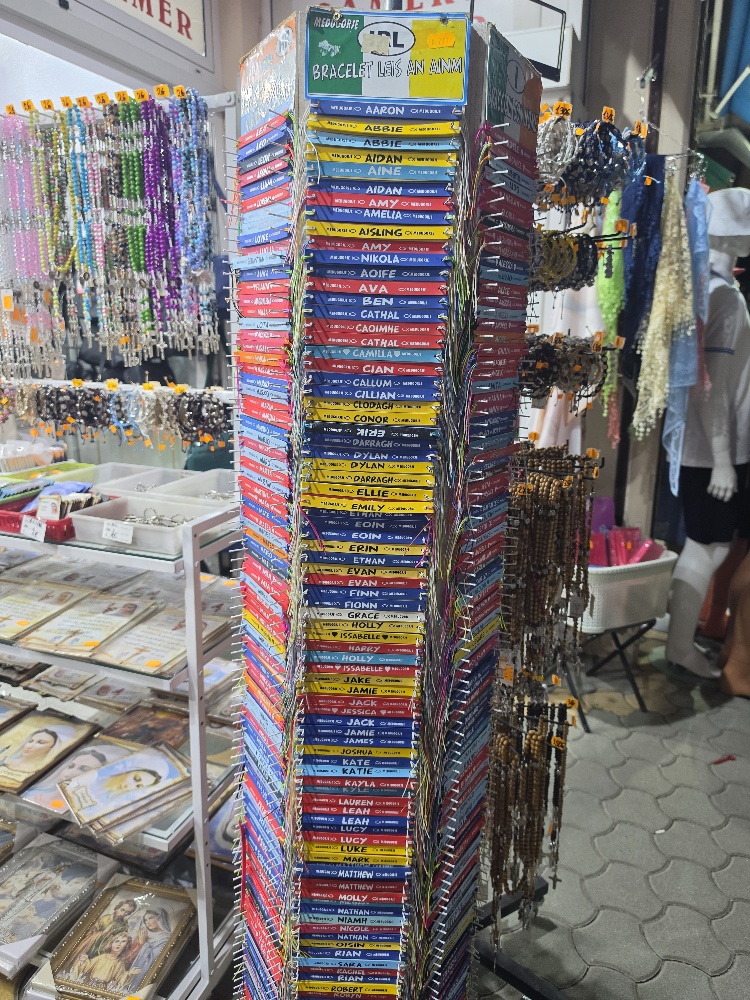
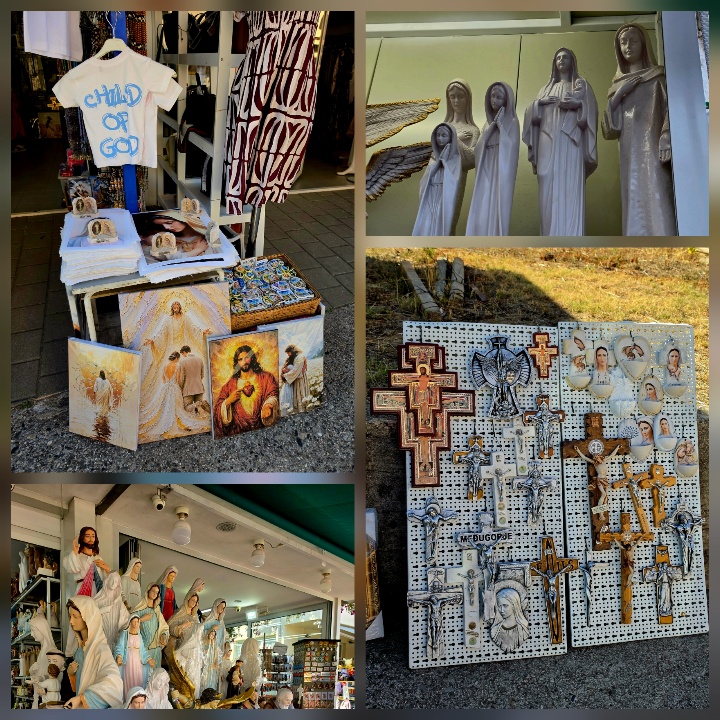
Walking the main street down to St James’s Church is like walking through a shopping mall for Catholics. The streets are lined with shops offering every Catholic accoutrement you could think of, from rosary beads, to statues, to key chains and holy medals. Canvas paintings of Our Lord were particularly compelling, but I resisted.
What is it with us Catholics and our accessories?
While I got there when it was empty, later, at open-air Mass in St James’s, the crowds appeared. Hundreds form orderly queues for confessions, either in the confessionals or on a bench. Priests pick their language cards and set up shop. My guy was hearing confession in French, Dutch, and English. There was a little bit of excitement and line shuffling when a German-speaking Bishop appeared. Rank draws its fans.
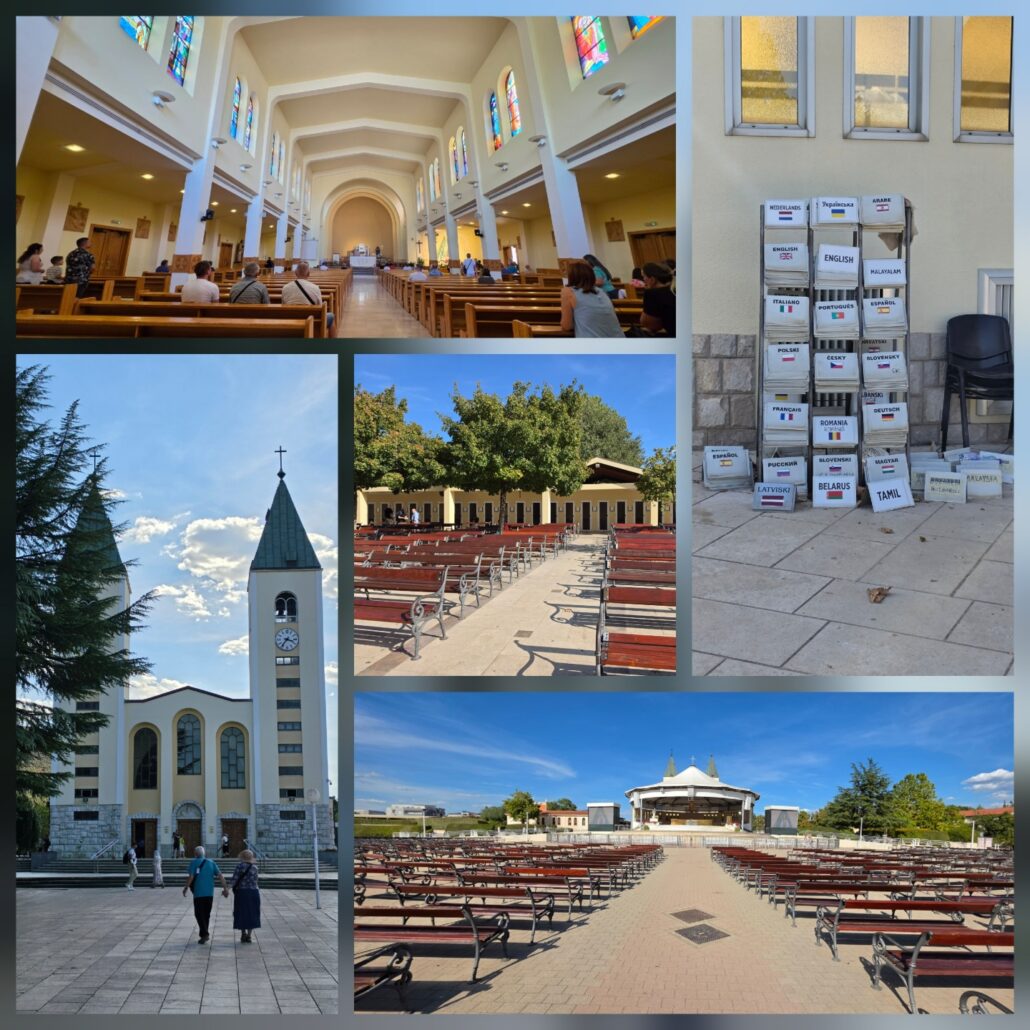
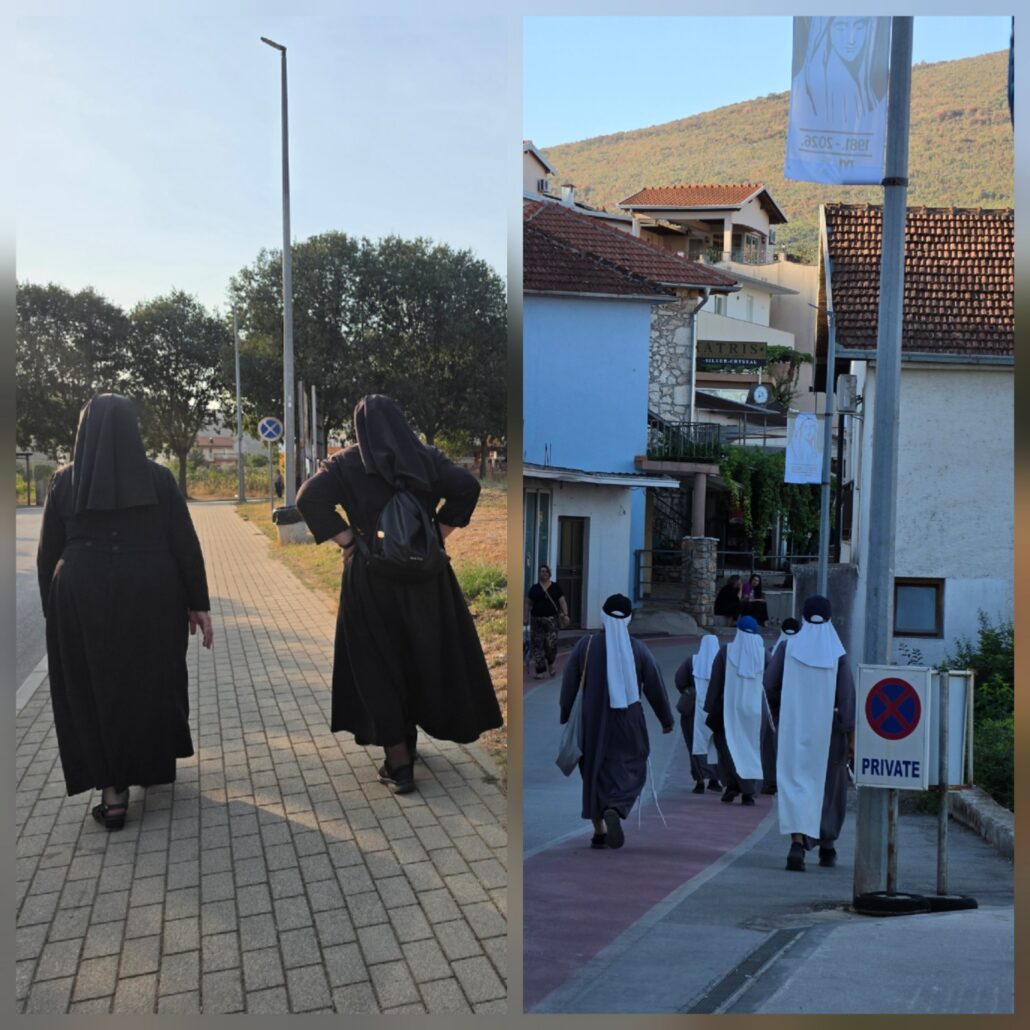
At communion, about 40 priests appeared from the main altar and came into the crowds. On the Saturday, marking the 800th anniversary of the death of St Francis, the place was swarming with Franciscan friars. And nuns. Hundreds of them. Young, too. In fact, that was the most impressive part of the whole experience – that there were so many young religious and young pilgrims. And so many young men in particular.
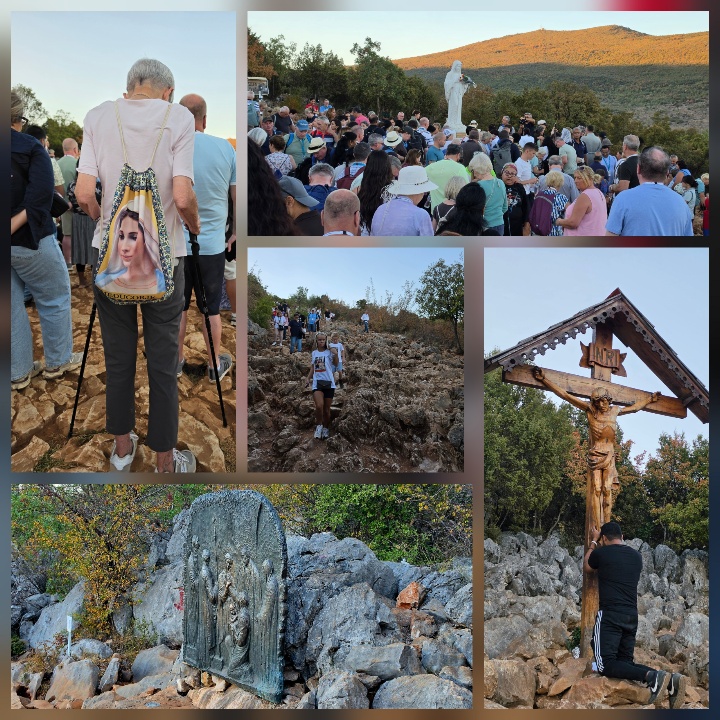
We got up before dawn to climb Apparition Hill, the place Our Lady first appeared. It’s not for the faint-hearted. And you definitely need both hands free to balance. Some people were doing it in their bare feet.
At the top, a crowd had gathered around the statue of Our Lady. A woman was speaking, reciting messages from Our Lady – it was Marija. One that stuck with me was a warning about the dangers of social media. I’m currently undergoing a rethink.
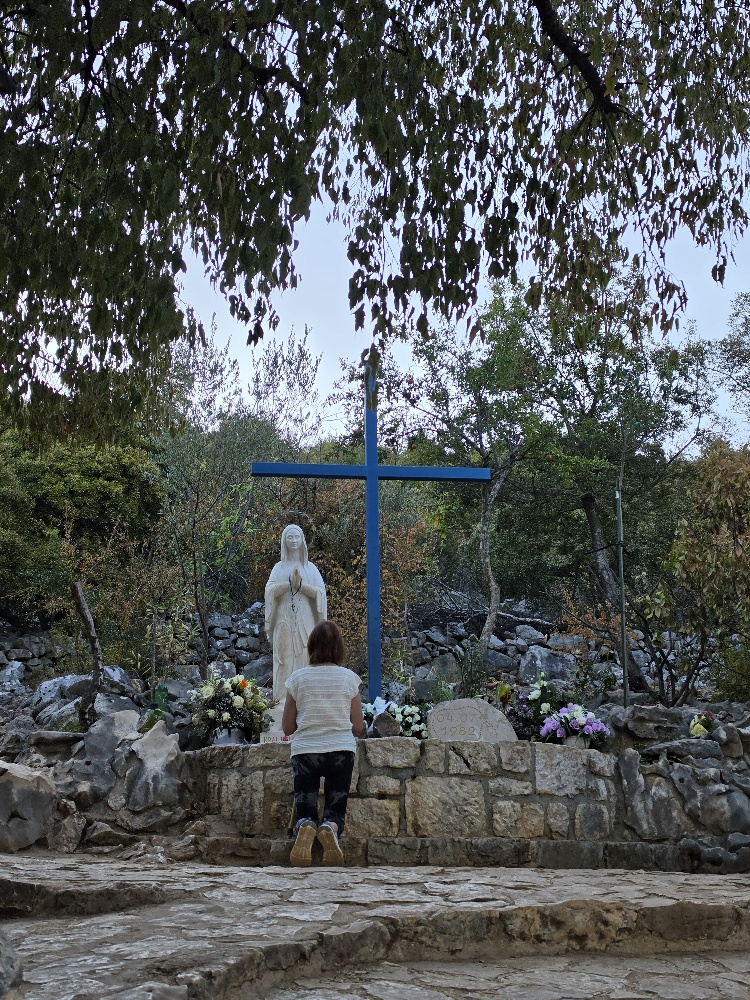
There are two blue crosses at the base of Apparition Hill; each has its own story.
A prayer group was regularly meeting at the first place of the apparitions, but soon the police discovered this. On the evening of July 27, we were walking to the site of the first place of apparitions when suddenly Ivan the visionary knelt down. This place where Ivan knelt became the site of today’s Blue Cross. That same evening, Our Lady told Ivan not to proceed to the first place of the apparitions, as the ‘blue angels’ (the communist police) were waiting for them. Our Lady, on several occasions, stopped the prayer group at the Blue Cross, as they were on their way to the first way of apparitions. We travelled the back way to the first place of apparitions because we thought that only we knew that way – not even the police knew of that back way.
The 30-foot Statue of the Risen Christ also draws a crowd. People line up patiently to touch their pieces of cloth (small squares of linen sold in packages in all the shops inscribed in lots of languages) to the right knee that is said to ooze liquid (about a litre a day), defying scientific explanation.
I had a fleeting image of Jesus sitting somewhere on a wall, watching this and laughing at the good of it. For all its emphasis on faith, Catholicism is a very tactile religion. We want to touch it. Wear it. Display it.
Anthony De Mello, the Indian Jesuit author of my all-time favourite book, Awareness, puts it controversially in Chapter 22:
‘Your priests are not going to be happy to hear this (notice how prudent I am this morning), but God would be much happier, according to Jesus Christ, if you were transformed than worshipped [sic]. He would be much more pleased by your loving than by your adoration.’
And indeed, the five stones (a metaphor for spiritual practices) of Medjugorje are quite personal:
The Five Stones of Medjugorje are five spiritual practices associated with the Medjugorje tradition: prayer (daily Rosary), the Eucharist, Scripture (daily), fasting (Wednesdays and Fridays), and confession (monthly). Inspired by David’s five stones before facing Goliath, they are regarded by pilgrims as spiritual tools for strengthening faith and overcoming sin.
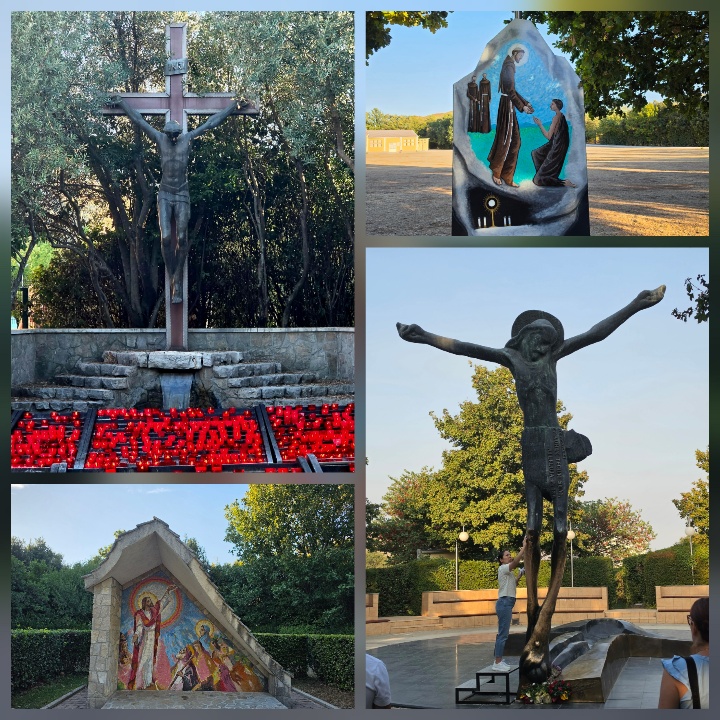
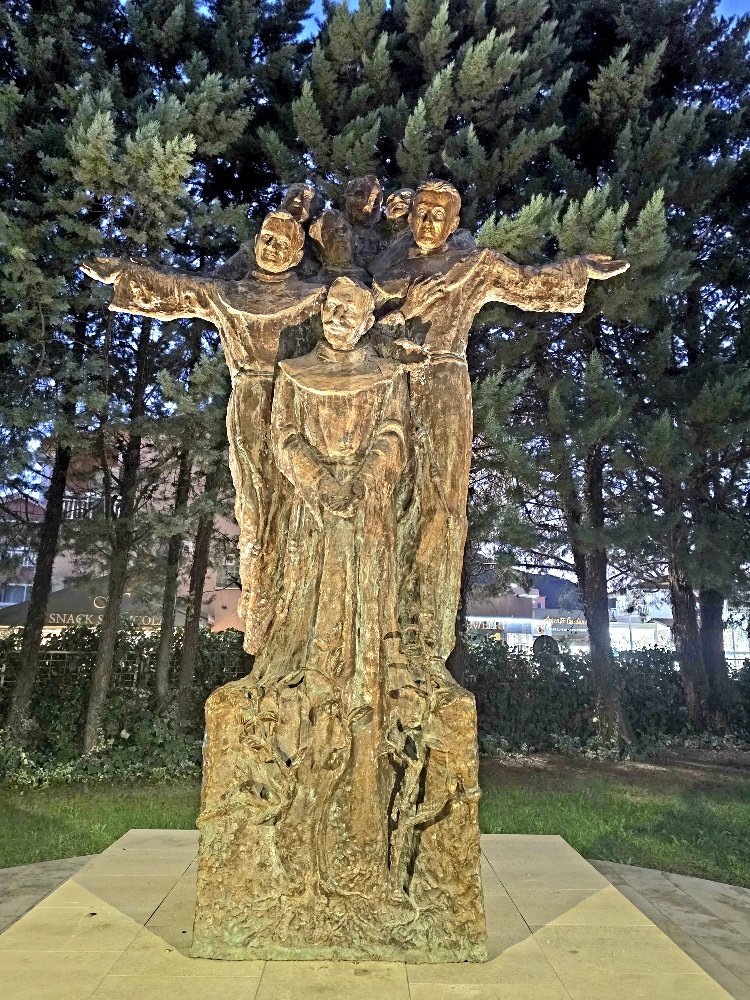
The shrine is run by Franciscans, who have strong ties to the area. There’s a Memorial to the Seven Murdered Franciscans of the Međugorje Parish (Spomenik sedmorici ubijenih fratara iz župe Međugorje) in a small park where the original parish church stood.
The monument commemorates seven Franciscan priests connected with the Međugorje parish who were killed during or immediately after World War II, most at the hands of Yugoslav Partisans/communist forces.
- Fr. Jozo Bencun — born in Međugorje in 1869; killed in Mostar on 14 February 1945, and his body was thrown into the Neretva.
- Fr. Marko Dragićević — born in Međugorje in 1902; a professor at the Franciscan high school at Široki Brijeg; taken from an altar while celebrating Mass and killed in February 1945.
- Fr. Mariofil Sivrić — born in Međugorje in 1913; worked at Široki Brijeg; taken by Partisans and subsequently killed in 1945.
- Fr. Grgo Vasilj — born in Međugorje in 1886; Guardian of the Franciscan monastery in Mostar; killed on 14 February 1945 with other Franciscans and thrown into the Neretva.
- Fr. Jenko Vasilj — born in Međugorje in 1914; killed during the Križni put (Death March/Cross Way) in May 1945 in the Croatian Zagorje.
- Fr. Križan Galić — killed in 1944 at the parish house in Međugorje, where he was serving as assistant parish priest.
- Fr. Bernardin Smoljan — former parish priest of Međugorje; killed in Mostar in 1945. He is particularly significant locally because he helped parishioners build the Cross on Križevac (Cross Mountain) and began construction of the new parish church.
I found the commercialisation quite dispiriting. Sadly, we didn’t discover the back way to St James’s that avoids the main shopping drag until our last morning. It costs €15.50 to get a mass said, plus the cost of the card. At home, it’s €6. Candles are €1. And the daily collection at mass has to be eye-watering. Google tells me:
Economic studies estimate that religious tourism brings over $100 million USD annually to the town of Medjugorje. During peak months, the parish can distribute upwards of 175,000 Holy Communions with hundreds of priests concelebrating daily. Even modest individual donations from such large crowds result in significant overall financial support for the shrine’s expansive infrastructure.
I felt like I did when I went to the Holy Land – overwhelmed. Not by the sanctity, but by the commercialism. I couldn’t see past it.
I would like to go back, but I’d go between November and February.
When it’s colder.
And many of the shops are closed.
And there are fewer people.