

Summer is coming. Short of moving to the Southern Hemisphere, there’s little I can do to avoid it. I’m not a hot weather person. There’s a limit to the clothes I can take off, but there’s no limit to what I can put on. Give me subzero temperatures over 40 degrees any day.
The occasional hot day we’ve had so far has attuned my delicate sense of smell to the onslaught of odours to come. I have already packed my perfumed cotton handkerchief in its sealed plastic bag in preparation for the day I get trapped on the tram under a malodorous armpit. It will come. It always comes. Like death and taxes, it is unavoidable.
But this year, I have a Plan B. I’m quite taken with the idea that a lot of families living in Budapest have a holiday cottage somewhere outside. I, too, plan on escaping the city on its hottest days and taking myself off to the countryside. I’ve written before about the calming delights of the forest in Gödöllő and expect to visit regularly this summer. I’m also keen to go back to Ráckeve and perhaps explore a little more of Csepel Island. And then, of course, there’s Szentendre.
Ask almost any tourist who has been to Budapest what they did while they were in the city, and chances are you’ll get the triad: walked the Castle district, went to the baths, and did the ruin pubs on Kazinczy utca. Those who were here a little longer than a two-day weekend might also add that they managed to fit in a day-trip to the riverside town of Szentendre. And while it’s lovely in its own way, I can’t say that it’s ever really done much for me. But Szentendre Island? Now, that’s a completely different story.

This 56 km2 island in the middle of the Danube, not far from Budapest, is an oasis of lush foliage and green fields, banked by clear, flowing water. Connected to the mainland by a single bridge, it is also accessible using the ferry service from Tahitótfalu, Vác, or Dunakeszi.
The island’s history can be traced as far back as 896 AD. It seems to always have been an agricultural area, supplying the nearby cities of Buda and Pest with produce. As we drove around, I was reminded of the green fields of Ireland and had little trouble imagining rural village life, Magyar-style.

From north to south lie the villages of Kisoroszi, Tahitótfalu, Pócsmegyer, Surány, Horány, and Szigetmonostor. Pócsmegyer is home to the Berczelly Mansion, a one-storey Baroque style mansion built by the Esterházy family in the late seventeen hundreds. The springs of Szigetmonostor supply a lot of Budapest’s potable water. But it was Surány we wanted to see, and in particular, the beach.

The tiny village of Surány, with its gorgeous little church and outdoor pews doesn’t boast much in the way of city-style entertainment. There’s a pub one side and a büfé on the other. Because the pub doesn’t do food, they don’t mind you bringing in a takeaway. How civilised is that?
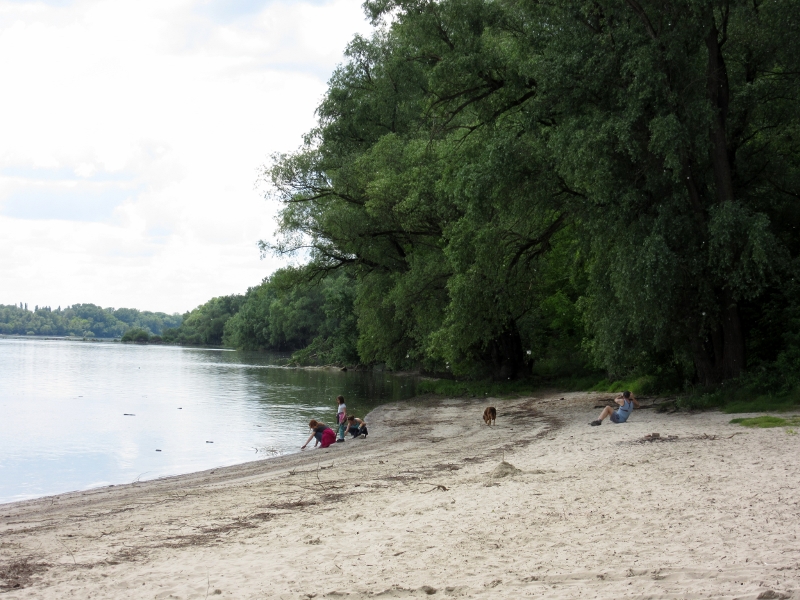
It does have a couple of beaches, lovely sandy stretches that run alongside the Danube. The water looked cool, clean, and inviting, so different to the same river that runs through Budapest. Some old-style employee summer complexes stand witness to the days of yore and indeed many of the houses are still original … from the small, two-roomed stone cottages to the more palatial riverside family homes. And, of course, if things ever get too quiet, there’s always Szentendre.
By car is simplest, but it’s doable by public transport, too, making it a perfect bolthole for those hot summer days when the air in Budapest stands still and the madding crowd gets too much to handle.
First published in the Budapest Times 20 May 2016