
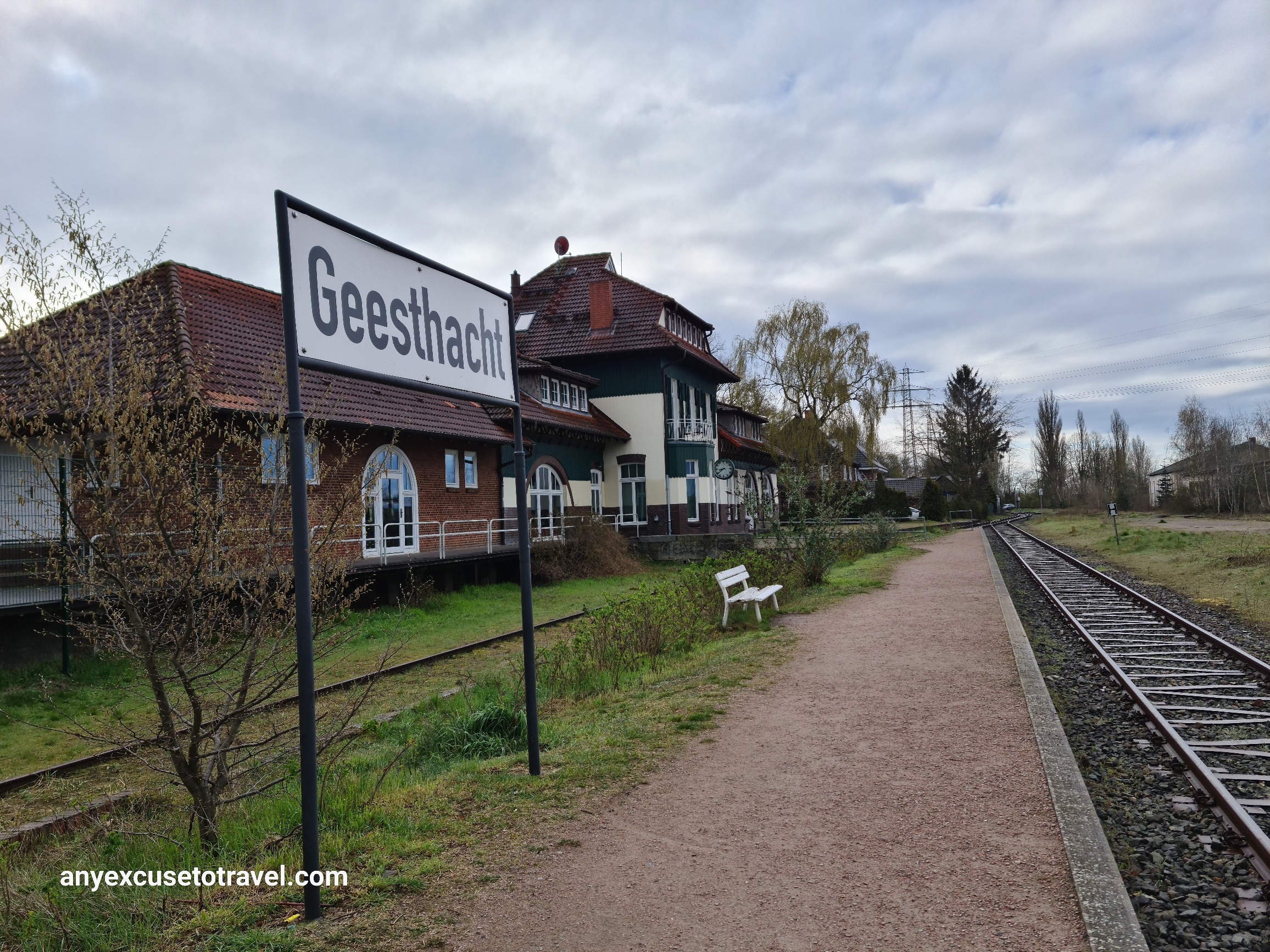
When a change in the course of a river splits a town in two, it leaves something special behind. No one told me that. I figured it out for myself after spending a couple of days in Geesthacht (geest is a rolling landscape formed by ice-age glacial deposits), the largest town in the northern German state (second-smallest in the country and the first German state to be totally green – 100% of its energy since 2014 is from renewables) in present-day Schleswig-Holstein.
The river in question is the Elbe.
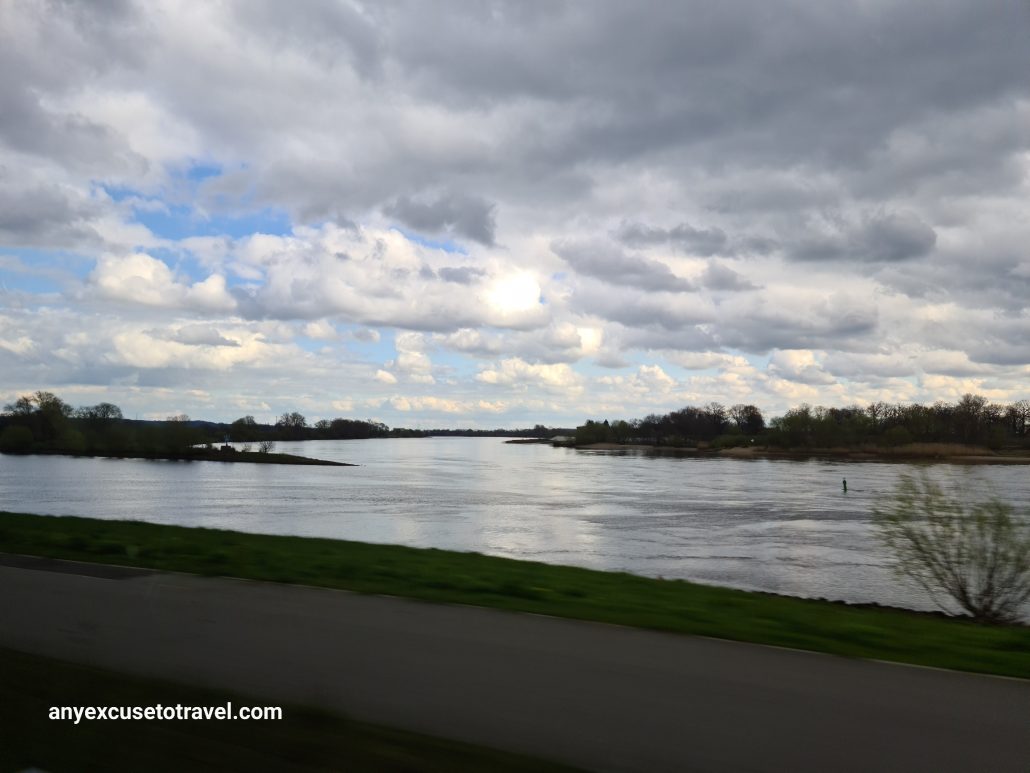
The town has been passed from pillar to post. In the late 1300s, Duke Eric III pawned it to Lübeck as part of some deal or other. Three decades or so later, Eric IV took it back by force. It was then ceded to Hamburg by the Peace of Perleberg in 1420. Fast forward about four centuries and it was annexed to the French, but only for a couple of years. All this time, Lübeck had a share in it, which it finally sold to Hamburg in 1868, who gave it town privileges in 1924.
From 1918 to 1933, the lifespan of the Weimer Republic, Geesthacht was known as Little Moscow, a hat tip to the number of radical leftist parties active in the town – USPD, KPD and SAPD – all who seem to have worked underground against Nazism.
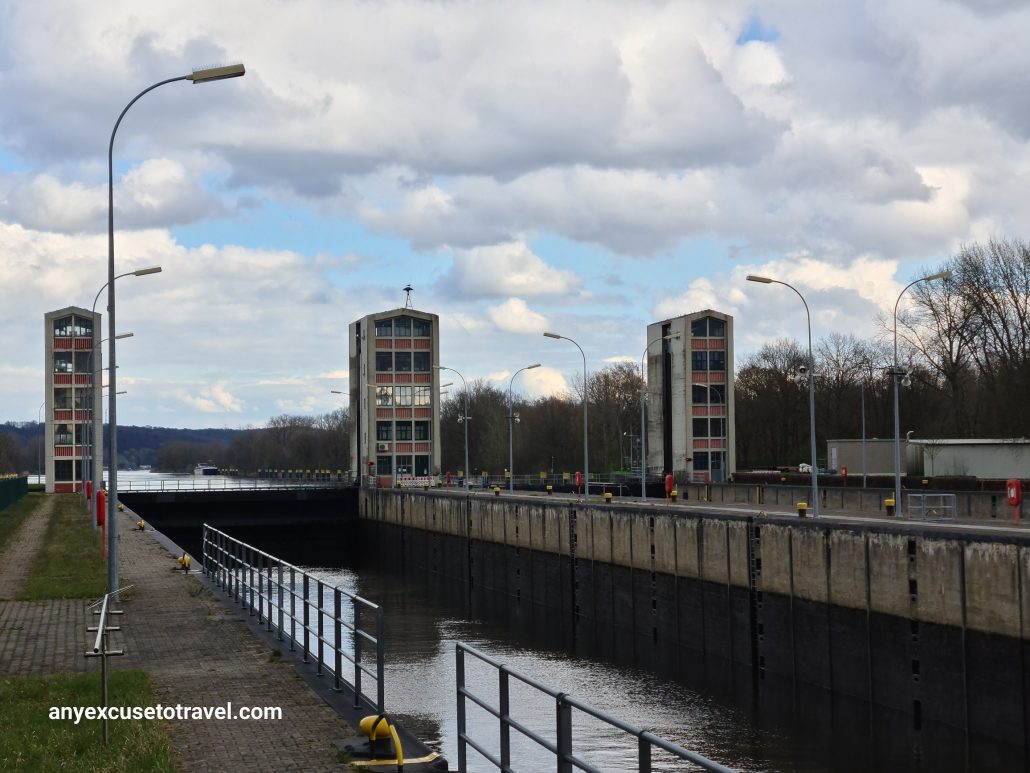
Once known as Germany’s powder chamber, today, it’s a major energy and scientific research hub. It has the whole smorgasbord – the Helmholtz-Zentrum Geesthacht research institute, a now-closed nuclear power plant, a nuclear reactor, a hydroelectric plant, a water dam, and a bevvy of wind and solar plants. There’s a technology tour you can take – what a brilliant idea – if you’re interested in the technical aspects of all of these, including the locks. Me? I was wondering if the lock buildings could be converted into apartments and who cool would that be?
Large, thatched houses had me briefly wondering if I could live here … post-Lotto win, naturally. They’re very impressive and, despite their apparent sturdiness, they’ve fallen victim to what sounds like a conspiracy theory: ‘a cellulose-chomping fungus from Eastern Europe, which was originally developed for the paper industry, and which may have somehow leaked out’ may be turning the reed roofs into ‘smelly white, black or green sludge’.


Detached. Semi-detached. Terraced. End of terrace. Bungalow. Dormer bungalow. Two-storey. Cottage. Mansion. These are how I might describe houses. In this part of the world, though, it’s a little more complicated.
The Geestharden house (German: Geesthardenhaus), also called the Cimbrian house (Cimbrisches Haus), Schleswig house (Schleswiger Haus), Slesvig house (Danish: Slesvigsk gård) or Southern Jutland house (Sønderjysk gård) due to its geographical spread in Jutland, is one of three basic forms on which the many farmhouse types in the north German state of Schleswig-Holstein are based. The other two basic designs are the Gulf house (including its variant, the Haubarg) and the Low German hall house. By far the best known variant of the Geestharden house is the Uthland-Frisian house (Uhtlandfriesische Haus or Frisergård), which is also referred to as the Frisian house (Friesenhaus).
I suspect, though I don’t claim to be an authority on the subject, that the latter are the ones I covet. I quite fancy a Friesenhaus.
And, in the field, I’d have a herd of Holstein-Friesian cows.
I’m not a complicated person. I find pleasure in the simplest of things. When I realised I was in the state of Schleswig-Holstein, my mind immediately went to cows. Not that I saw any while I was there, but from some dark recess of my mind, a childhood squabble came to mind – were the black-and-white cows on my granddad’s farm Holstein or Friesian… now I know. They’re Hostein-Friesian. It took a few lifetimes to get there; now I can rest easy.
The town’s old church, St Salvatoris Kirche, is simple and all the more beautiful for it. Gold and glitter are in short supply. Instead, the wooden interior is decorated with colourful frescos. Built partly from the stones saved from the first church in town (1230) sacrificed to the Elbe, today’s half-wooden church dates to 1685.


A bit of trivia
I wonder how many of my German friends know that Prince Phillip, husband of the later Queen Elizabeth of England, is also prince of the House of Schleswig-Holstein-Sonderburg-Glücksburg (what a mouthful!). The title is just a title unencumbered by power or responsibility. But who knew?
Notes for the next time I’m in the state
- Go north to the largest national park in central Europe – the Wadden Sea National Park.
- Walk around the old trading town of Lübeck, which, along with the park, is a UNESCO site.
- Stay on the island of Sylt (I imagine this as Germany’s answer to Martha’s Vineyard).
- Visit the high sea island of Heligoland, which the British tried to blow up in WWII.
- Pay my respects at any or all of the four memorials to victims of the Nazi regime – Ladelund, Husum-Schwesing, Ahrensbök, and Kaltenkirchen.
- Avoid Wacken in August, when tens of thousands of metal heads descend for the largest heavy metal fest in the world – Wacken-Open-Air.
- Instead, check out the castles, palaces, and churches hosting Schleswig-Holstein Music Festival.
- Don’t miss the Eutin Festival: a lakeside open-air opera festival.
- Think about Kiel Week in June, both the largest sailing regatta in the world and the biggest summer festival in northern Europe.
I stayed at the Hotel-Restaurant Holsteiner Hof, right beside the railway station. Built in 1902, it’s a friendly place with good food, within walking distance of the Elbe. And they rent bikes and have a bike/motorbike lockup. It’s such a shame that the trains no longer run into Hamburg, though. That would have been perfect.
And from now on, when I watch something that may have been filmed in Germany, I’ll be keeping an eye out for the local Hotel zur Post, a very popular film/TV location. I’m definitely going to check out Nord bei Nordwest, a TV crime series filmed here.

Geesthacht might have been known as Germany’s Little Moscow back in the day. Today, it’s building its tourist brand and attracting cyclists and tech lovers to the banks of its part of the River Elbe.

9 responses
Reserve one of those lock houses for me!
It’d be a cool place to live!
Thanks for letting us in on your travel experiences and insights!
Thank YOU for reading…
My grandmother was baptized and probably married in St. Salvatoris Church. Her father owned a laundry in the middle of the village. His name was Walter Strauer. He died in Germany, probably during World War II. Mt paternal grandfather, Ulrich Brugmann, emigrated with my grandmother, Alice
(Strauer) and my father, Jurgen, who was three years old, to America, in May of 1930. In Geesthacht, there is a Brugmannstrasse, named after someone in the family.
Have you been back to visit, Benita?
Finally i can go to my mothers birtrh place,Geesthauct,at 74 i will now see where she was born and worked at 15-19 years of age ,1940-1945,at krummel factory,here maiden name was Franck,i can not trace any German relatives,and am not computer literate,however,she said she worked at explosive factory at 15-19 years old,You have really enlightened me with your by chance article on Geesthaucht,
Thank you,its a must before i pass as i have barely any German family history,mom said her farther was shot for following communist beliefs in 1930,s in Geesthaucht,thats all i know and her maiden name was Franck,i am english and do not speak german,Help.
Again thank you for the article with out it i would not ever have related to this town.
I really hope you make it there, Peter.