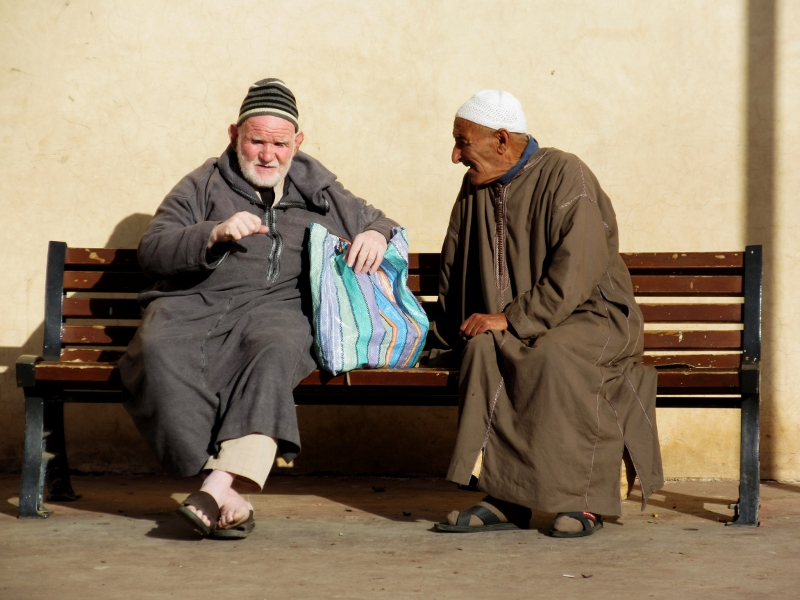
I can sit for hours and watch the world go by, blatantly staring at the teeming masses that flow back and forth as I sit and nurse a coffee. Admittedly, it’s been a while since I’ve taken the time to do so but it didn’t take me long to get back into the swing of it all. Such is Marrakesh. And in particular, the main square – Place Jemaa el Fna.

Jemaa el Fna is a hive of cultural activity. From snake charmers to dancing boys. From storytellers to musicians. From chained Barbary monkeys to traditional-hatted Berbers. This is where it’s all happening. The massive square is surrounded by the famous souks and myriad cafés and restaurants, all looking outwards at the spectacle on display. It’s like open-air theatre at its best – unscripted, spontaneous, and highly entertaining.

I had heard of the UNESCO Masterpieces of the Oral and Intangible Heritage of Humanity – something along the lines of a Word Heritage status except that it’s not for a city or a town or a building but rather for a tradition. But I hadn’t realised that it was born in 2001 at the urging of those concerned that the cultural heritage on show at Jemma el Fna was in danger of dying a slow but steady death at the hands of economic development.
| “ | The spectacle of Jamaa el Fna is repeated daily and each day it is different. Everything changes — voices, sounds, gestures, the public which sees, listens, smells, tastes, touches. The oral tradition is framed by one much vaster — that we can call intangible. The Square, as a physical space, shelters a rich oral and intangible tradition. | ” |
|
— Juan Goytisolo, in a speech delivered at the opening meeting for the First Proclamation, 15 May 2001
|
||

Yes, if you dare to take a photo of a snake charmer in action you have to cough up the 10 MAD (€1) for the privilege. And if you offer anything less to the musicians, you’ll be shamed publicly. Forget about trying to sneak a picture of a monkey or three. Moroccans are far from shy when it comes to naming and shaming. And they have eyes in the back of their head. For every one performer, there’s a bevy of watchers with ears attuned to the digital click of cameras and phones.

Morocco is 98% Muslim. I found that a little intimidating and so far out of my comfort zone as to be almost alien. If there are rules, I like to know them, so at least I’ll know what it is I’m breaking. Kissing in public is frowned upon but that’s okay – I’m not one for public displays of affection. I was more concerned about whether it was okay to show my ankles. They seemed to attract quite a lot of attention – mainly from matronly middle-aged women in full garb. I was concerned, too, about stopping for a coffee in a café with all men seated outside. And I was a tad bothered about whether or not to cover my head. But apart from the ankle stares, it seemed pretty lax.

It did take me a while though to marry this 98% Muslim statistic and the religion’s thinking that homosexuality is a crime with the number of men strolling the streets holding hands. There are only five Muslim countries where homosexuality is not a crime – and Morocco isn’t one of them. I did a few double-takes before I got used to it all. Interesting though that my gay friends could walk hand in hand in a country where being gay is a crime and me, as a heterosexual woman, thought twice about holding hands with a man. And, of course, last year, there was the case of Ray Cole – the British chap who got jail time after being arrested in the city for partaking in homosexual acts. Yep – Marrakesh, and Place Jemaa el Fna, are nothing if not interesting.

I was fascinated with the robes (djellabas) and the women’s penchant for ankle-length furry, animal print, hooded, buttoned dressing-gowns (well, that’s what they reminded me of). Mad altogether.
With a 60:40 ratio of Berber to Arab [the Arabs arrived around the 7th Century and converted everyone to Islam, while the Berbers are the original inhabitants], children are whatever their father is. So with a Berber mum and an Arab father, the children will be Arab. The pointy hoods when worn up at night gave me the heebie jeebies. And while I never felt in any danger, the shadows were reminiscent of the KKK and did cause the old blood to flow a little faster.
I was most impressed by people’s ability to do nothing. So many just sat and watched. While others stood and chatted, No one seemed to be in a hurry to go anywhere. Conversation seemed very much part of the way of life, a refreshing change from the home where everyone is too busy online to have time to ask anything other than what the Wi-fi code is.

I saw the local women sporting all seven types of headdress from the hijab to the burka, although the latter I only saw once. Most wore niqabs or al-amiras. I found myself mentally chastising other foreigners who I thought to be inappropriately dressed and wondered at how quickly I’d become so judgmental. Never before have I been so put out at a bra strap showing. Whether it was fear or my innate sense of propriety working on overdrive, I’m not sure.

Sitting on one of the many rooftop terraces overlooking Jemaa el Fna as the sun sets is one of the more spectacular sights I’ve seen in my travels. The many calls to prayer compete for airspace as the muezzins recite the adhan. There was something a little suspect about the timing though, as they all seemed to be slightly out of sync. [I wondered fleetingly if all the Angelus bells in Ireland are synchronised.] And coming over the loudspeaker as they do, the human voices have an almost robotic quality that had me wondering if I was listening to a recording. [Yes, while I know something about some things, there’s a lot about which I’m clueless.] If you’re in Marrakesh, be sure and find a rooftop come dusk. It’s worth it.