
In Szeged last weekend for Porgy and Bess, I was followed by a feeling of disquiet the whole time I was there. It was as if something was going on and I was the only one who wasn’t in the know. I realise that university towns without their students are odd places to be and yet this feeling of ‘otherness’ couldn’t just be put down to the absence of half the town’s usual residents.

The city is old but doesn’t really look it. History tells us of the presence of mammoth hunters in the region 24,000 years ago. The name Szeged itself didn’t appear on record until 1183, when King Béla III granted passage to three ships carrying salt to the church at Nyitra. Now the third largest city in Hungary and home to the university that bears its name, there’s something about Szeged that isn’t entirely … well… Hungarian.

So I did some reading and discovered that the city was wiped out on 12 March 1879. It was almost completely and utterly destroyed by the flood which resulted from a breach in a nearby dyke. Only 265 of the existing 5723 houses remained. The world united to rebuild the city. The main streets feature Rome, Brussels, Berlin, Paris, London, Moscow and Vienna, a permanent reminder to the donations received from around the world to help with the reconstruction.

Wandering into town from the train station, relatively unimpressed by what I’d see thus far, the Gate of Heroes took me by surprise. Erected in 1936 in honour of those who had died in WWI, the arch is covered in frescoes painted by Vilmos Aba-Novák. When the communists came, they painted over the artwork and it wasn’t until 2000 that the frescoes were restored to their original form.

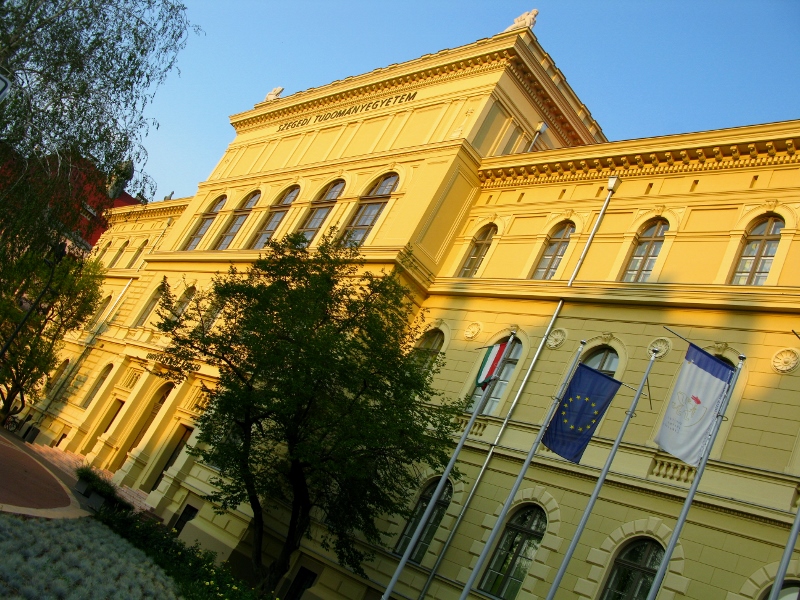
The university itself is lovely – and pretty much dominates the main square. I hadn’t realised that it was originally the University of Kolozsvár in Romania which began in 1872 and had to move to Hungary after the Treaty of Trianon in 1921. It was reborn as the University of Szeged and amongst its alumni is my favourite Hungarian poet, Jozsef Attila. From 1962 to 1999 it was actually call after him, too. Amongst its faculty it includes Nobel-prize winner Albert Szent-Györgyi, he who is tied forever with the isolation and extraction of Vitamin C from paprika.


Szeged definitely had the feel of a university town, even if the students were missing. Mind you, despite the added sense of summer culture that comes with the outdoor festival, I still couldn’t shake the feeling that there was something about Szeged that I just didn’t get. We tried the famous fish soup (excellent), shared a plate of tepertó (goose crackling), and slept the sleep of the innocent at the Hotel Mozart.We walked the banks of the Tisza and remembered the mayflies and got some great people-watching in. It was a lovely summer evening and there was plenty going on and yes, I’d go back. If only to try and figure out what it was that I missed.