
I’d confused Pontchartrain with Pondicherry.
Easily done.
One is in Louisiana, USA, and the other is in India.
As I said, easily done.
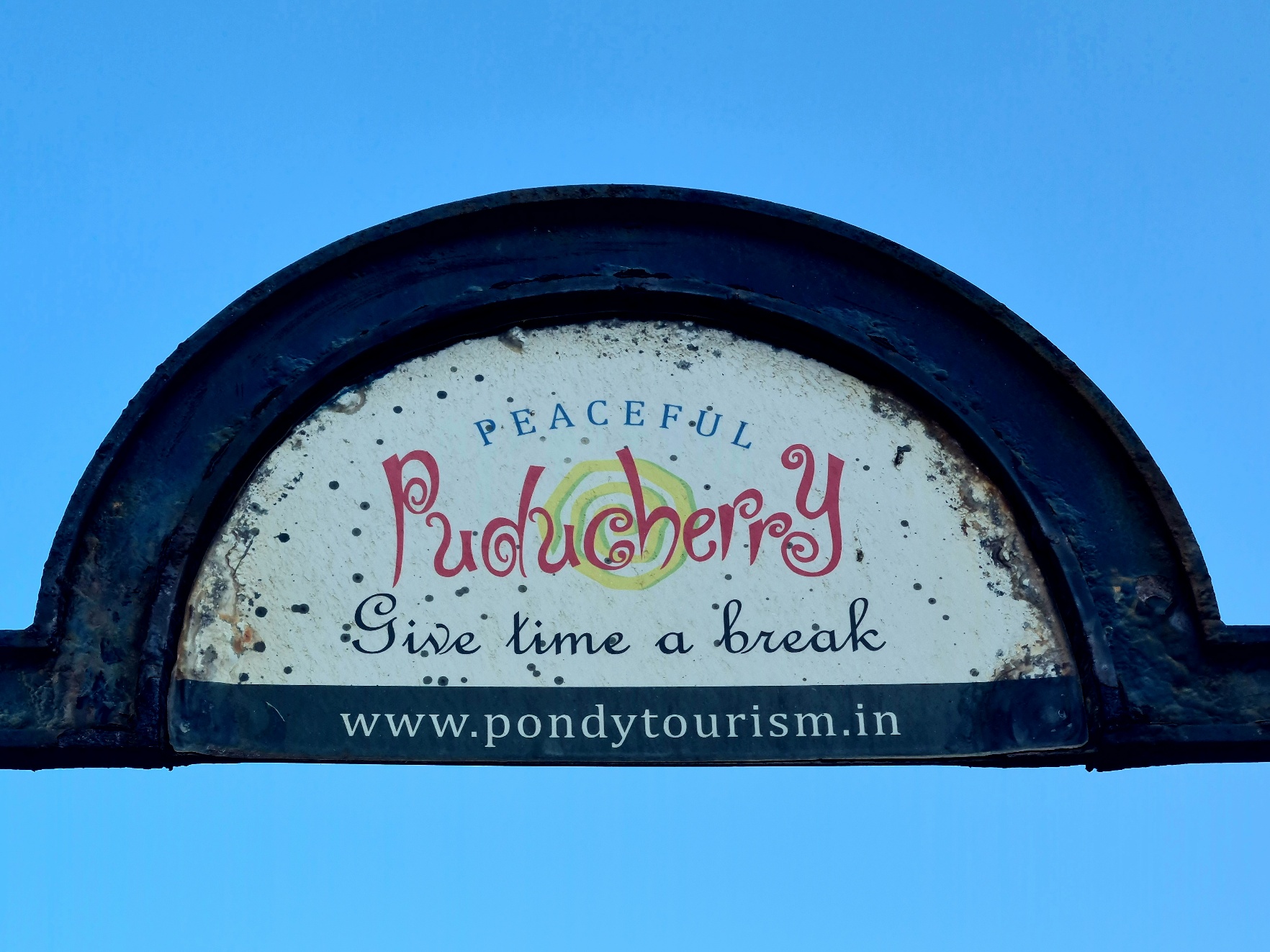
To confuse matters even more, Pondicherry is now Puducherry.
But it’s still in India.
It’s a Union Territory, not a state, like Tamil Nadu, or Kerala.
And its history would make your head ache.
In 1674 the Governor of “La Compagnie française des Indes orientales” (French East India Company) François Martin, set up a trading centre at Pondicherry and this outpost eventually became the chief French settlement in India. […] Pondicherry was captured by the Dutch in 1693 but was returned to French company by the Treaty of Ryswick in 1699. […] During the French Revolution in the year 1793 the British “East India Company” took control of the region and returned to the French “East India Company” in 1814. However, when the British “East India Company” gained control of the whole of India in the late 1850s, they allowed the French “East India Company” to retain their settlements at Pondicherry, Mahe, Yanam, Karaikal and Chandronagor.
In 1947, the independence of India gave impetus for the union of France’s Indian possessions with former British India and an agreement between French Government and India Government, in 1948, stipulated that the inhabitants of France’s Indian possessions would choose their political future. On a de facto basis, the bureaucracy had been united with India’s on 1 November 1954 and the de jure union of French India with the Indian Union took place in the year 1963. […] Pondicherry along with Karaikal, Mahe and Yanam was constituted as a Union Territory in the Indian Union.
Ye gads!
It was our last port of call this trip, one I’d been looking forward to immensely, even when I realised that it wasn’t the place Christy Moore had sung about.
No. That was Pontchartrain.
In Puducherry, a canal separates the historic French Quarter (once the exclusive home of French residents), known as White Town, from the local Tamil Black Town.
French is spoken everywhere. The street names are also in French. And the architecture, with the mustard-coloured colonial villas and the bougainvillea-lined cobblestone streets, is a throwback to the days when the French were in their prime. Indian Vagabond has some lovely photos that do the town justice.
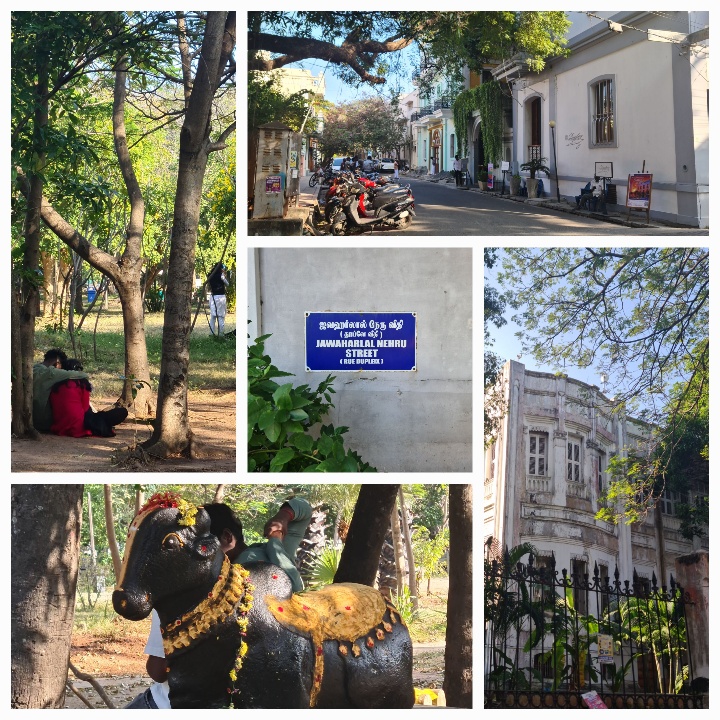
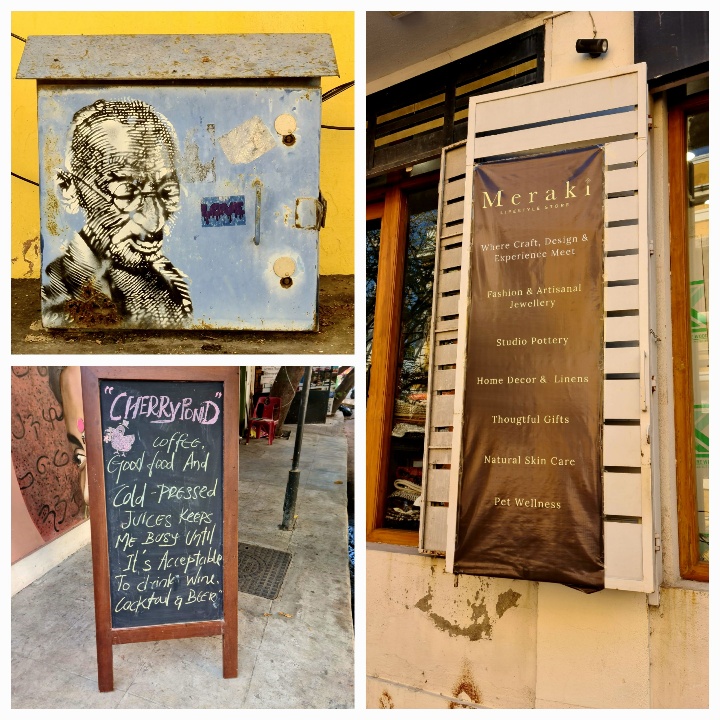
Add to that the cafés, the restaurants, and the boutiques, and the picture is complete. Even though it was given back to India in 1954, it’s as if time stopped. It’s still very French. And a tad mind-boggling.
A long promenade separates White Town from yet another unswimmable body of water, The Bay of Bengal.
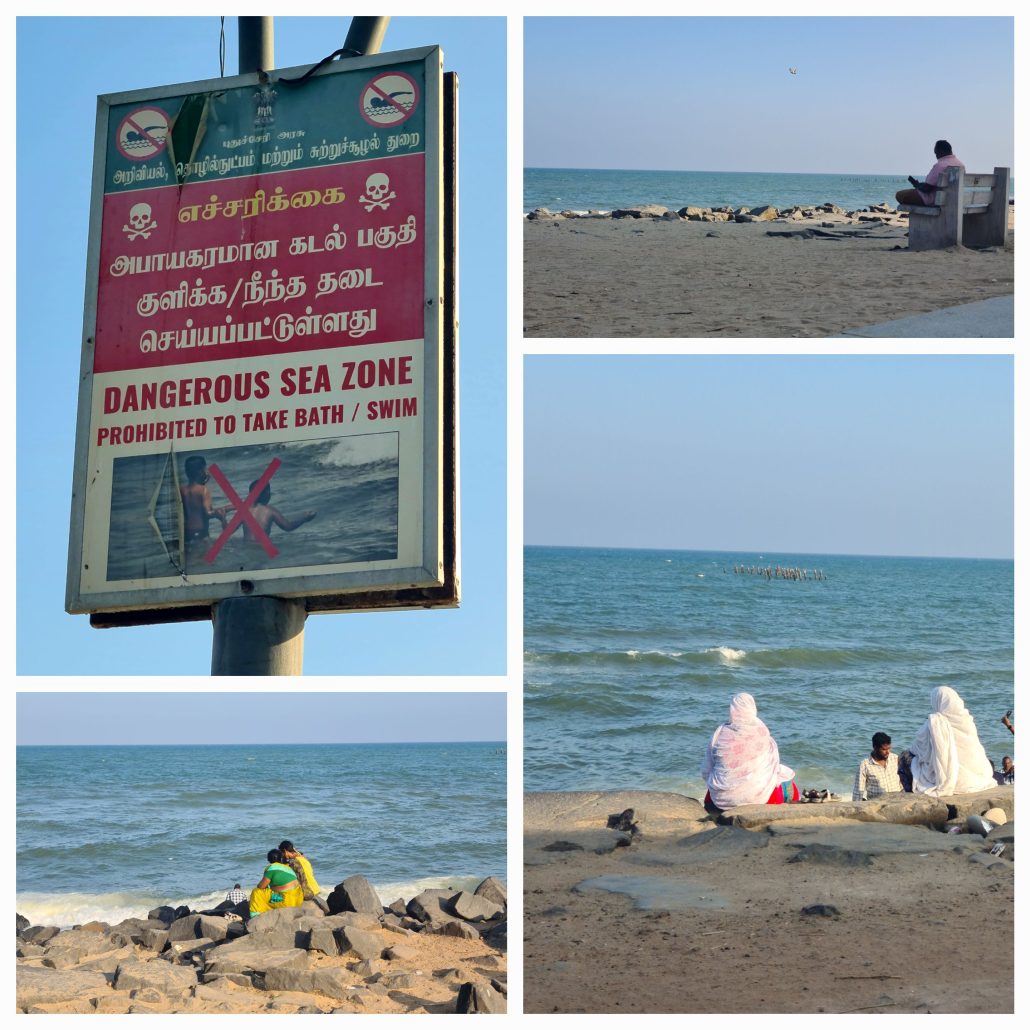
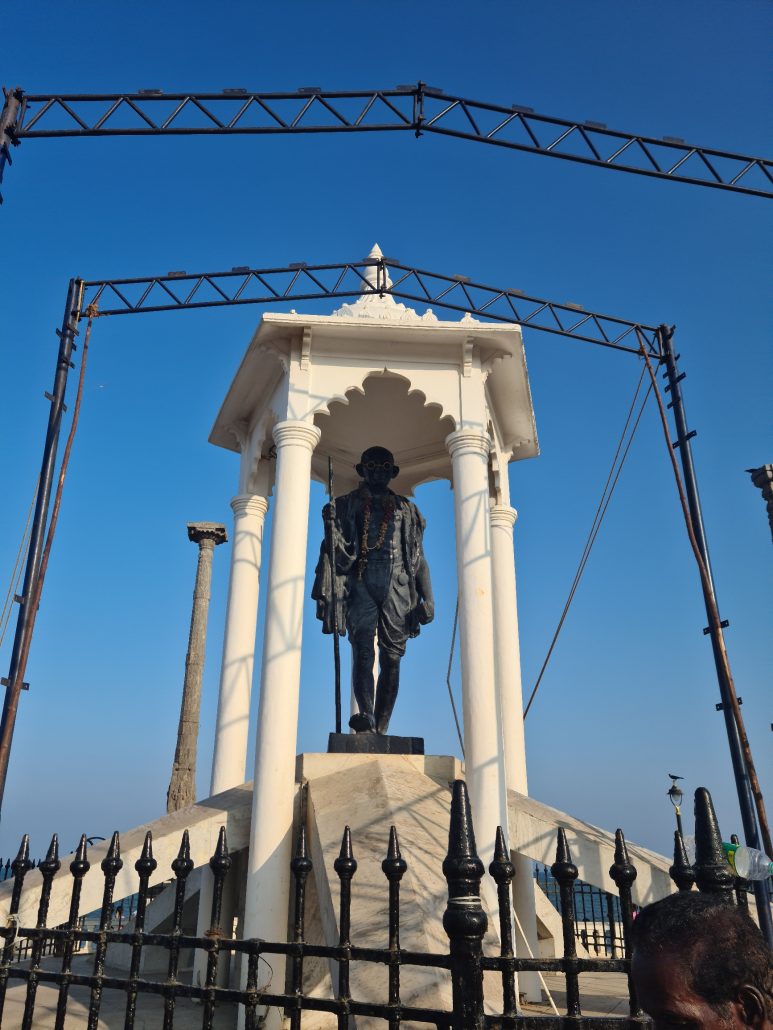
As we walked along the water heading towards the giant 4-metre (13 ft) bronze statue of Gandhi (I had to pay my respects), we could have been anywhere. The sea and the sun are great equalisers.
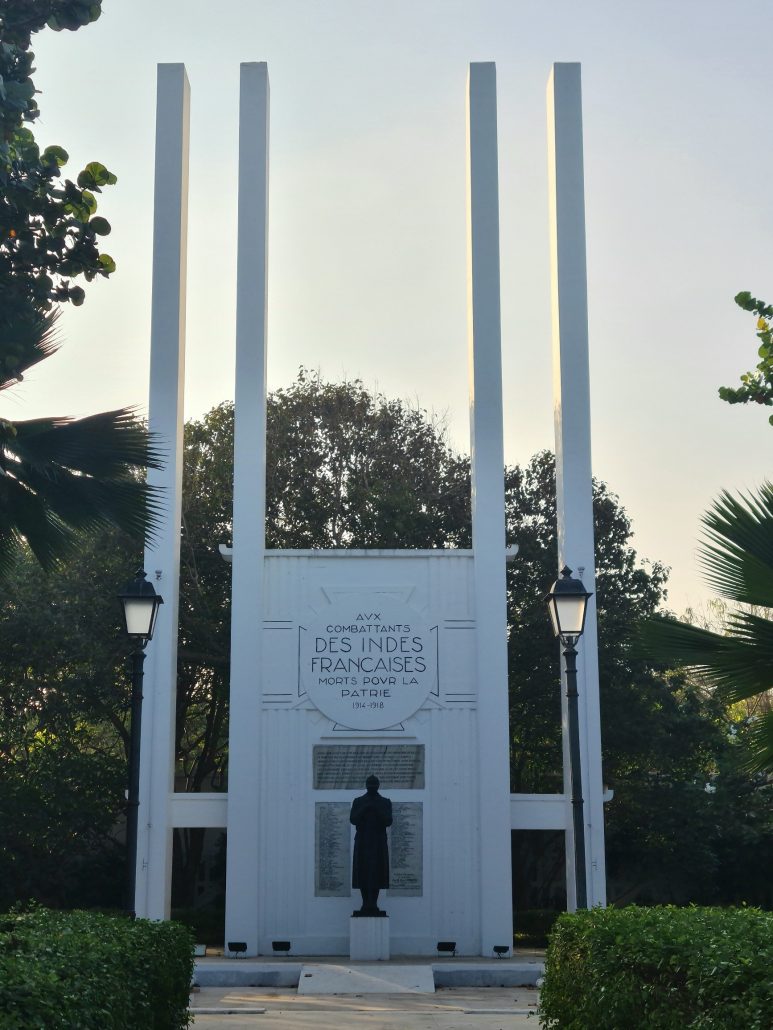
We passed the French War Memorial erected in 1938 to honour soldiers from French India who fought with the French in WWI. It was later added to include those from WWII, the French War in Indochina, and the Algerian War. About 800 in all. Simple and poignant.
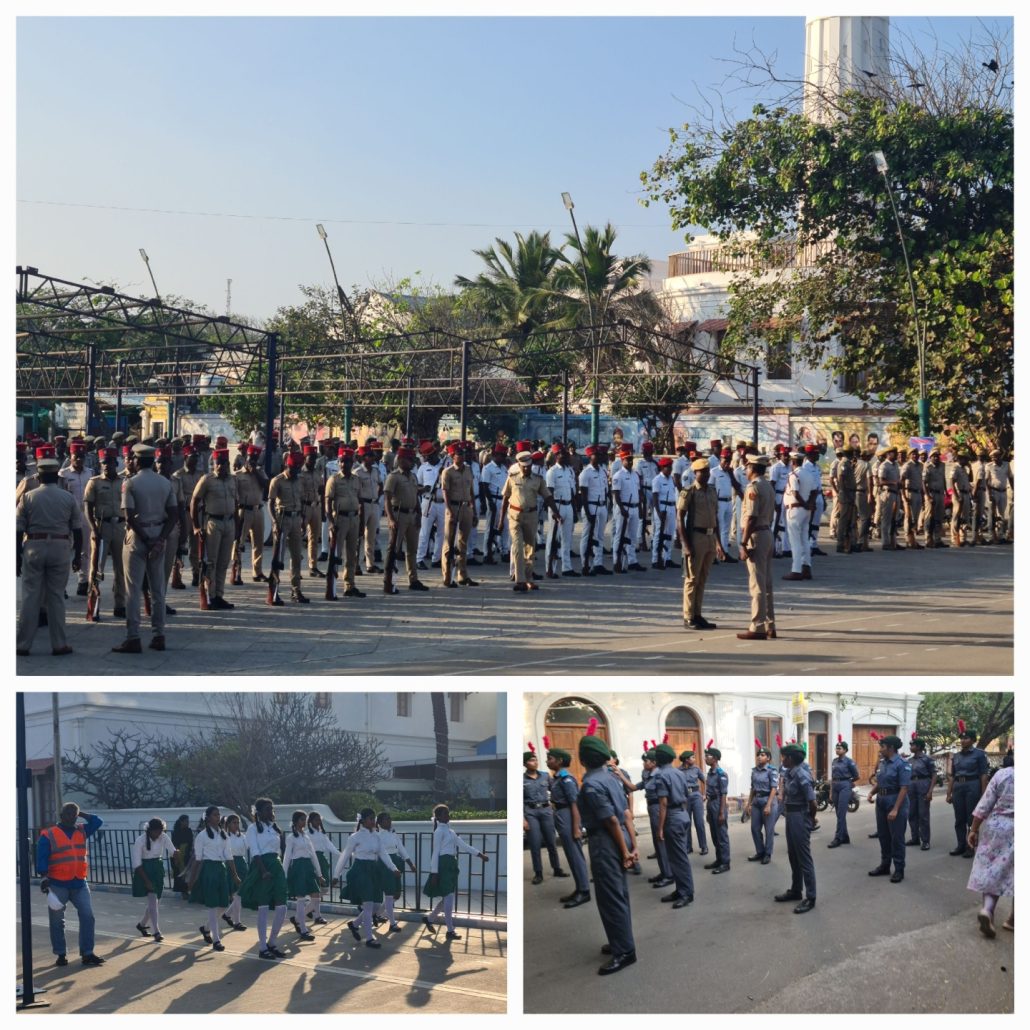
Schoolchildren of various ages were practising their marching for Republic Day. The local police and army were also out in force, doing their rehearsals. Everyone was in full uniform – and it was hot.
The Sri Aurobindo Ashram on Rue de la Marine is a focal point. The final resting place of The Mother, it’s visited by hundreds of people daily from all over the world. Most sit and meditate. It’s not somewhere you’d want your phone to ring. It’s a serious place.
I’m usually very at home in other people’s churches and holy places, but this was strange. We’d yet to visit Auroville (yes, I know, I reversed the final order of the trip), so I wasn’t quite sure what I was seeing, but even if I had known, I’d still have found it strange.
Why, I can’t say.
I don’t know.
It just felt strange.
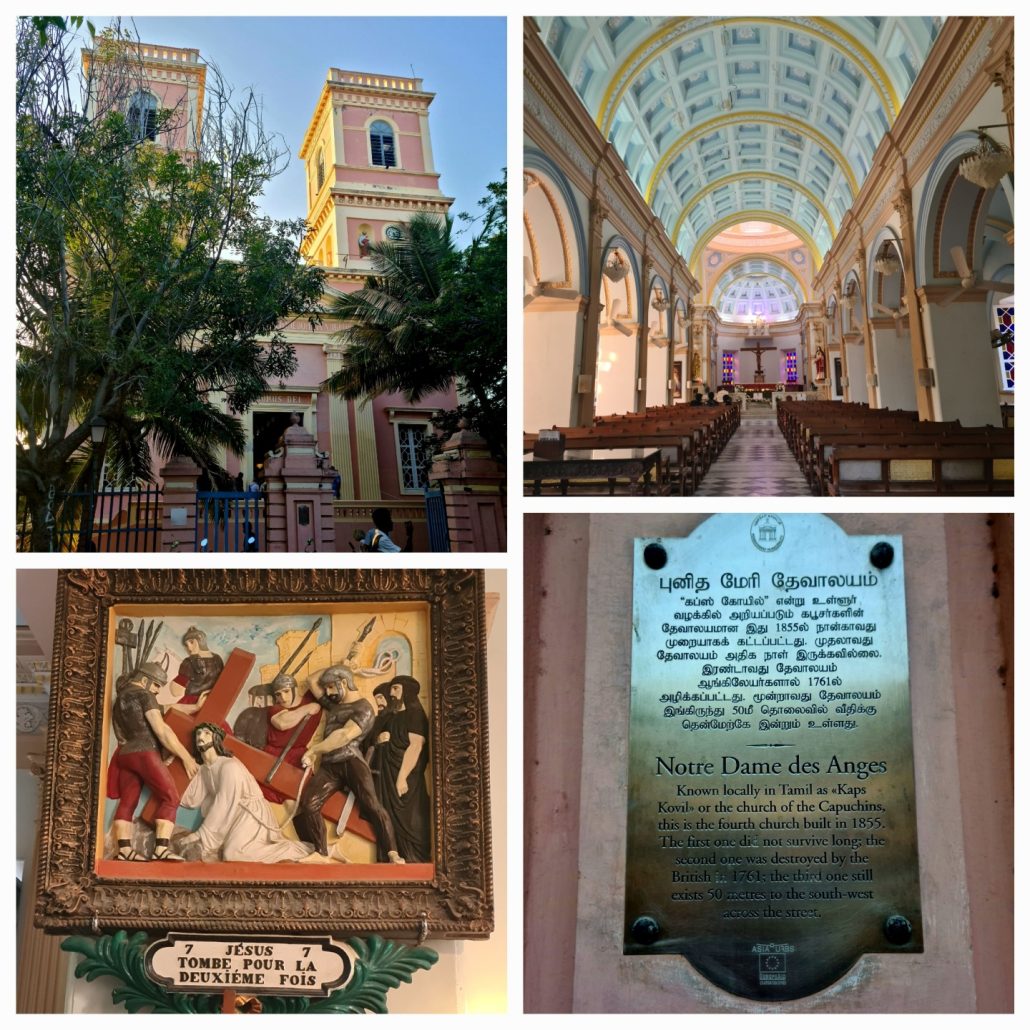
There are 10 churches of architectural note in the city; we only visited one – Eglise de Notre Dame des Anges – Our Lady of the Angels. Modelled on the Basilica of Notre-Dame in Paris, it has a stunning barrel-vaulted ceiling and is famous for using a mix of limestone and eggshells for its white walls. Dating to 1855, it’s one of the oldest churches in the region, and today, it’s the only place in town you can get mass in French.
Sadly, the Capuchin cemetery was closed, but it’s a good reason to go back. I did get to see the French cemetery, though, and a local Hindu one.
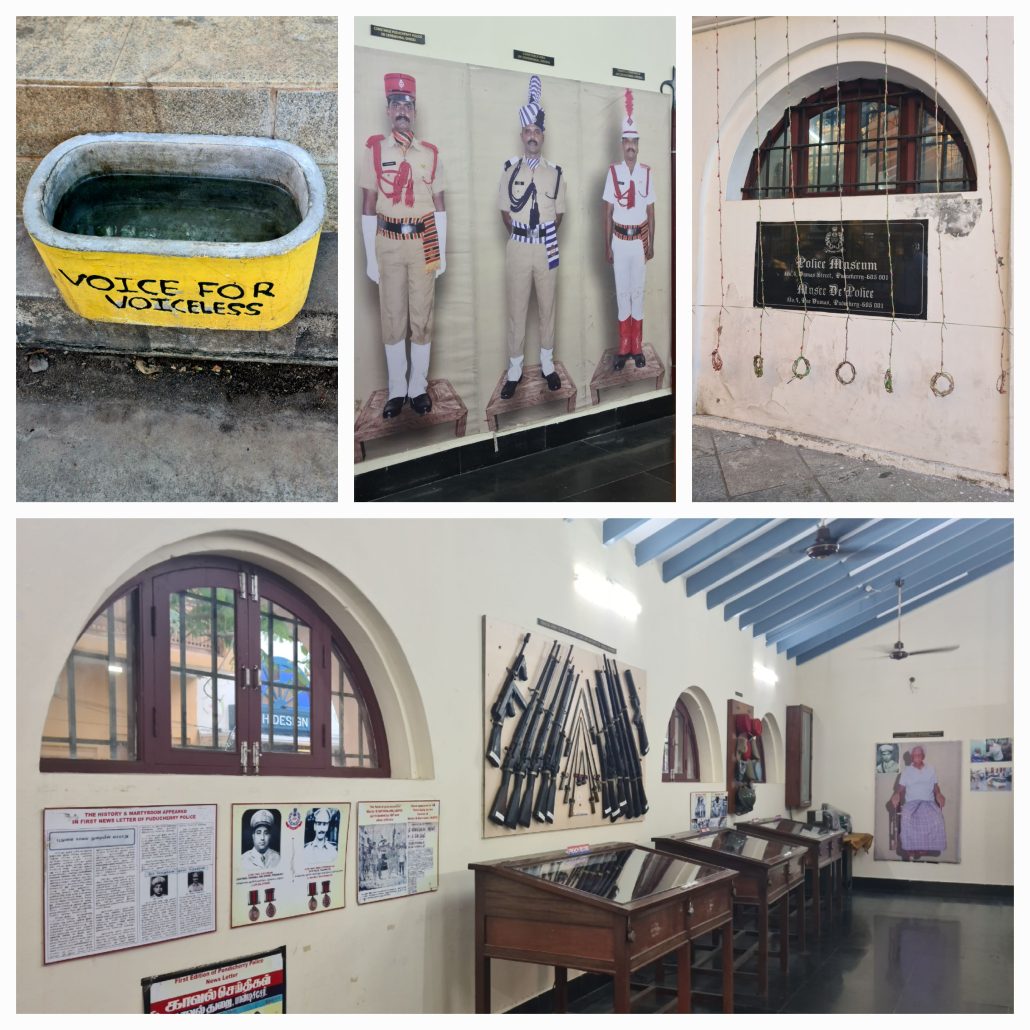
I stopped at only one museum – the police museum. I was struck by the box outside that said ‘voice for the voiceless’.
Cue digression:
I’m a big fan of the Delhi Crime series on Netflix, fictionalised drama based on real cases.
- Season 1: Focuses on the investigation following the 2012 Delhi gang rape case.
- Season 2: Follows the police dealing with the Kachha Baniyan gang murders.
We were a long way from Delhi, I know. I’d seen the Pink Patrol in Coimbatore, police cars driven by women officers to respond to calls from women and children 24/7. The state of Tamil Nadu has 202 All Women Police Stations (AWPS), operating solely for women and children. Sad that these are warranted, but good that the need is being recognised.
End digression.
I’d have liked to have spent more time there, a first for me on this trip. Even with my pathetic convent-school French. I liked the old-worldliness of it all. And the colours.
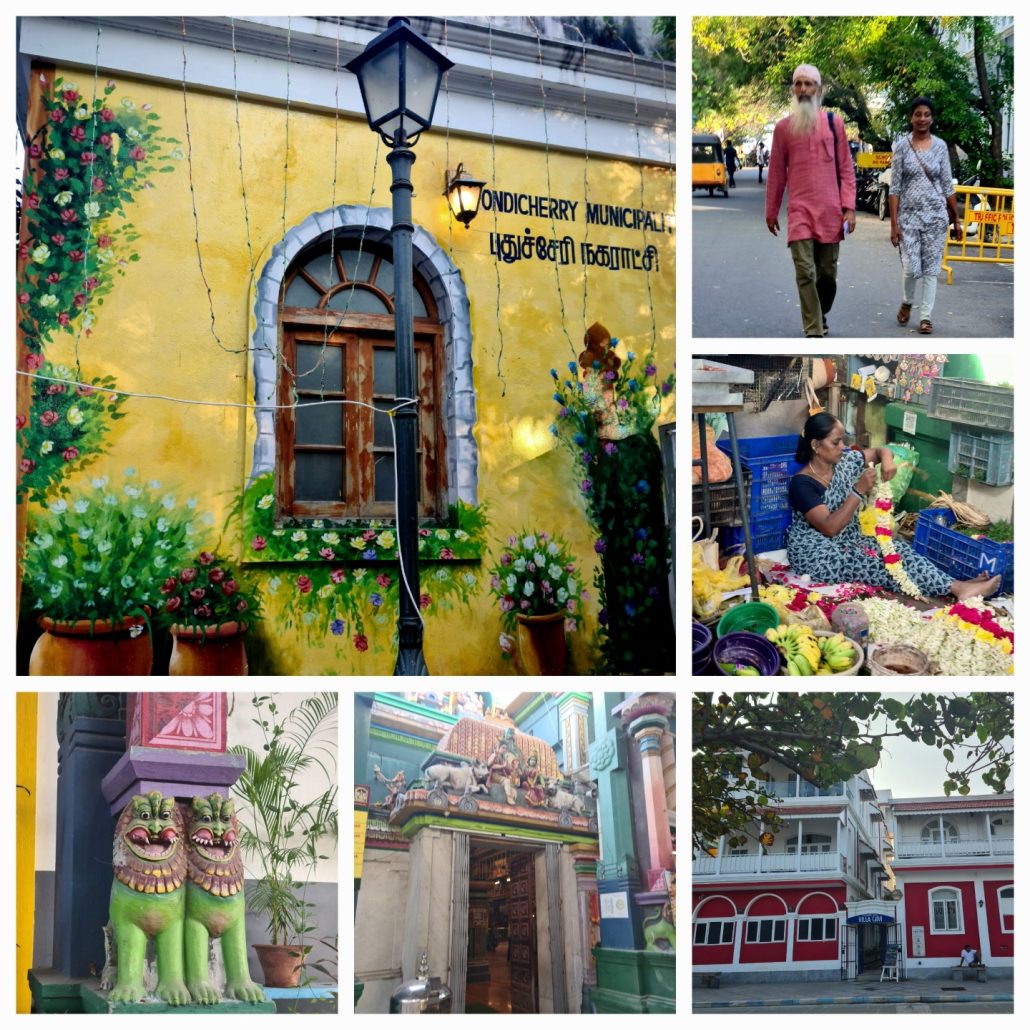
Of all the places we’d been to, Puducherry was the one where I could imagine myself spending more time. Perhaps it was the European influence juxtaposed with the complete Indian experience, a heady mix of both worlds. Perhaps I need to keep one foot in what’s familiar. Perhaps I will go back.