
Oh, yes, I thought, as I saw yet another woman of my age or older cruising around on their motorbike.
I could live here.
In Auroville.
Along with the 3300 other residents of 60 nationalities. Impressive. Mind you, our village in Hungary has 12 nationalities and 330 residents, so we have them beat in terms of diversity.
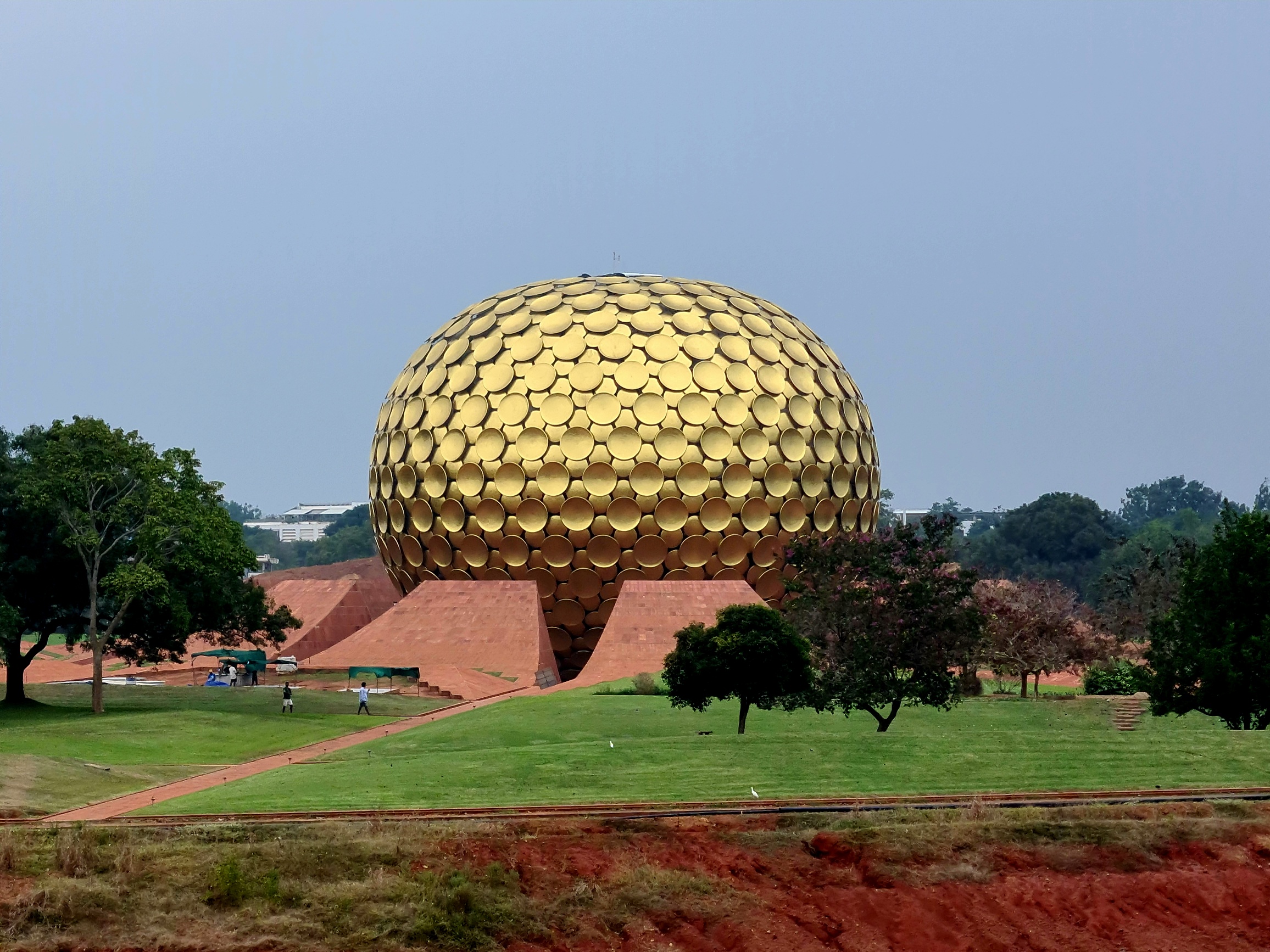
Auroville, sometimes referred to as “The City of Dawn” is conceived for 50,000 inhabitants from around the world. At the centre stands the Matrimandir, the “soul of the city”, a place for individual silent concentration, in an oval shaped Peace Area surrounded by a lake. Radiating out beyond the lake are four Zones – the Industrial (north), Cultural (north east), Residential (south/south west) and International (west) – each focusing on an important aspect of the town’s life. Surrounding the township is a Green Belt consisting of forested areas, farms and sanctuaries.
Founded in 1968 by Mirra Alfassa and designed by architect Roger Anger. His last name made me smile, given the nature of the place, and yes, I know, I should be pronouncing it with a French accent. Paulette Hadnagy published an interesting conversation with him that’s worth a read if you’re interested in the architectural aspect.
Auroville is Alfassa’s vision of…
…a universal town where men and women of all countries are able to live in peace and progressive harmony above all creeds, all politics and all nationalities. The purpose of Auroville is to realize human unity.
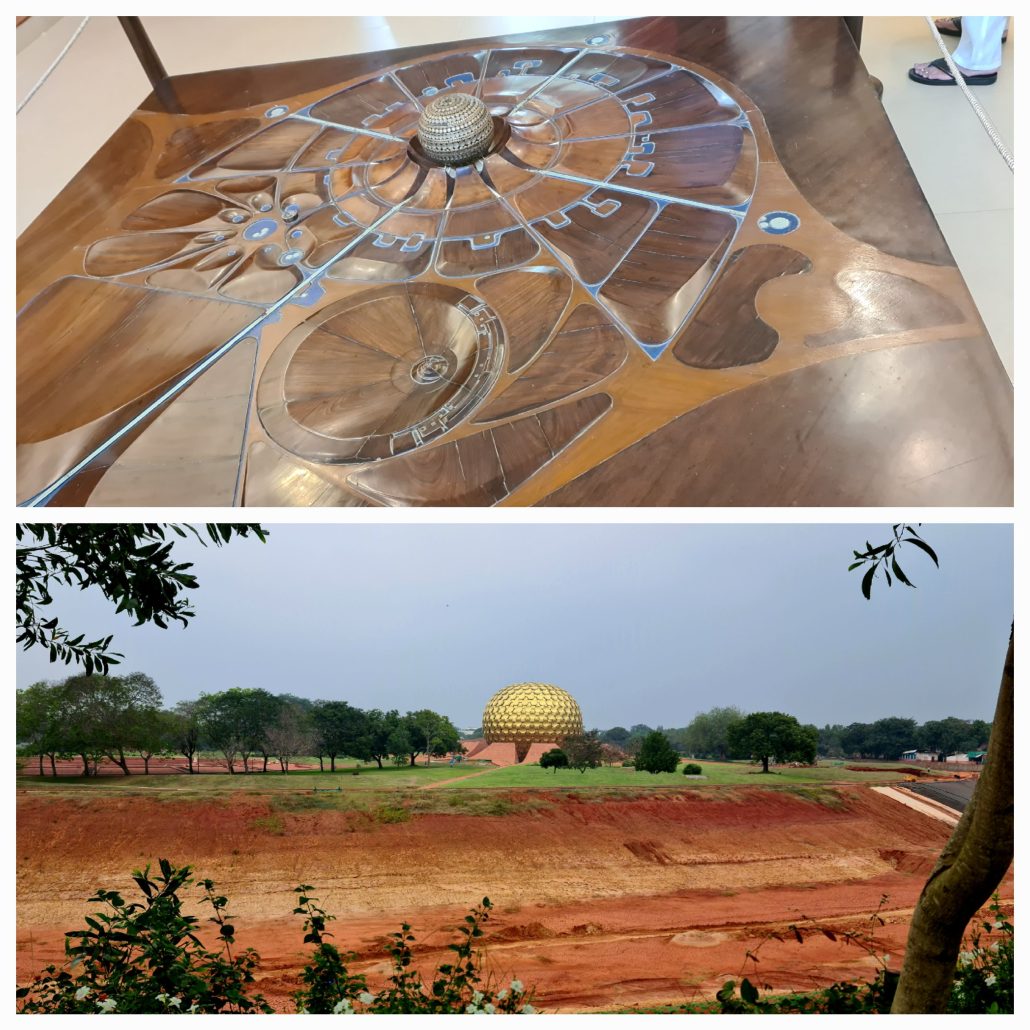
It’s still in the making. Even though Alfassa died in 1973, her vision still has life. The fundraising continues. Her plans are gradually being realised. Yet there was a commercialism about the place and the plans that struck me as being totally at odds with what, in my limited understanding, I had expected the place to embody.
Alfassa was born in Paris, France, on 21 February 1878 into a Jewish family. When in India (between spells in Algeria and Japan), she met the guru Sri Aurobindo. She’d later return to develop and manage his ashram. He was the one who gave her the moniker ‘The Mother’.
We’d come primarily to see the Matrimandir, the concentration centre, which I had initially confused with a concentration camp. A completely different beast entirely.
The Matrimandir, a huge gold disc-clad sphere, which seems to be rising out of the earth, symbolises the birth of a new consciousness. The Sanskrit word “Matrimandir’ means “Temple of the Mother” referring to the evolutionary, conscious and intelligent principle of Life which leads the human journey from its present limitations into the next stage of its evolutionary adventure.
Four times I attempted to register to visit, but I was either too early or too late for the short window during which reservations are accepted.
Perhaps for the best.
My flight of fancy was interrupted when I read the rules.
If you leave for more than two weeks without prior approval, your status can be terminated. In fact, departure and return dates for any absence have to be given to HR. And you can’t have guests for longer than 7 days without approval.
It’s the approval that got me.
Then, I thought, were I living in a retirement home, I’d be bound by similar rules. And maybe they wouldn’t let me have a motorbike.
The one that knocked any flicker of interest (remember, this trip for me was a lot about whether I could see myself whiling out my days in the country) is that you have to renounce your religion. That I’d find difficult to do. Especially when it would appear on the surface that I’d be exchanging one for another.
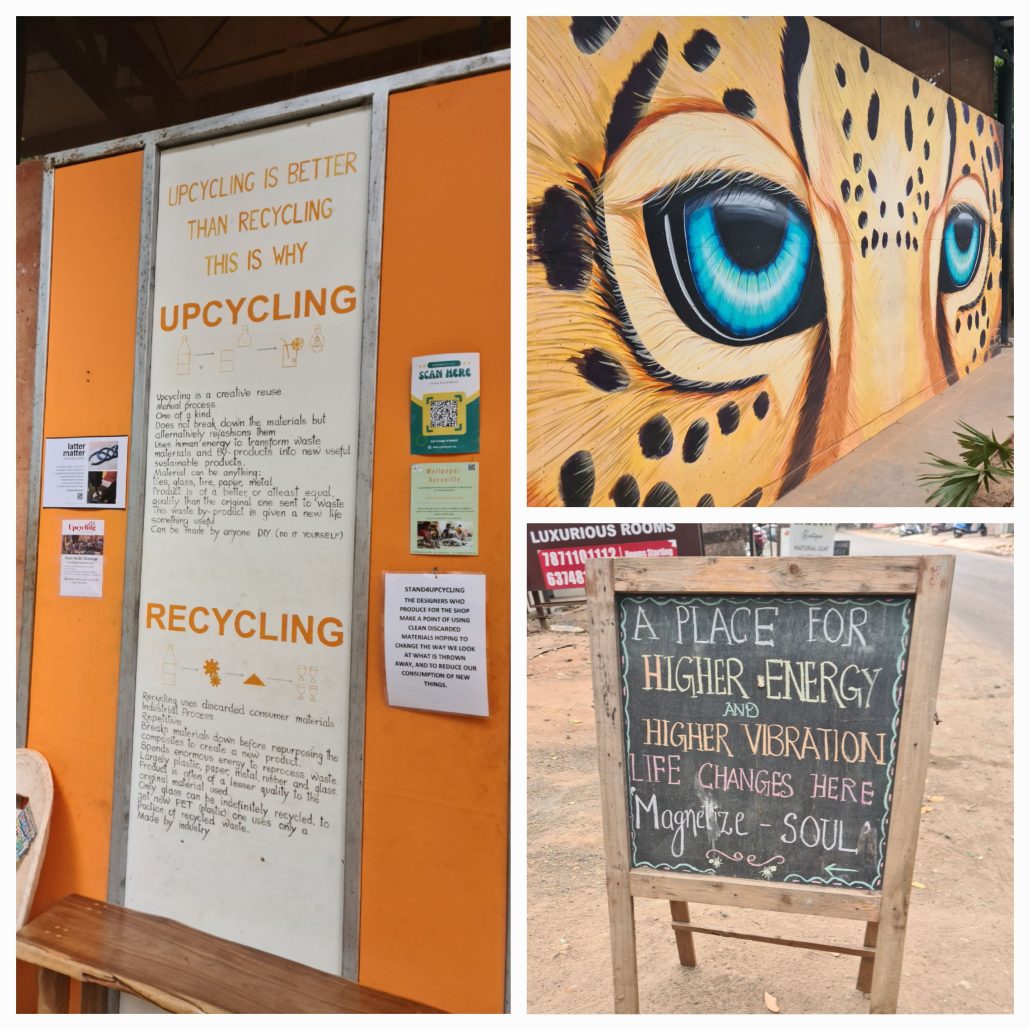
You can’t work for yourself. You can work for a community enterprise and draw a modest maintenance from it. The centre had several shops stocked with items made by residents – clothes, jewellery, art, toiletries, stationery, and some fabulous wind chimes (my weakness) and sound bowls. I particularly liked the upcycling shop.
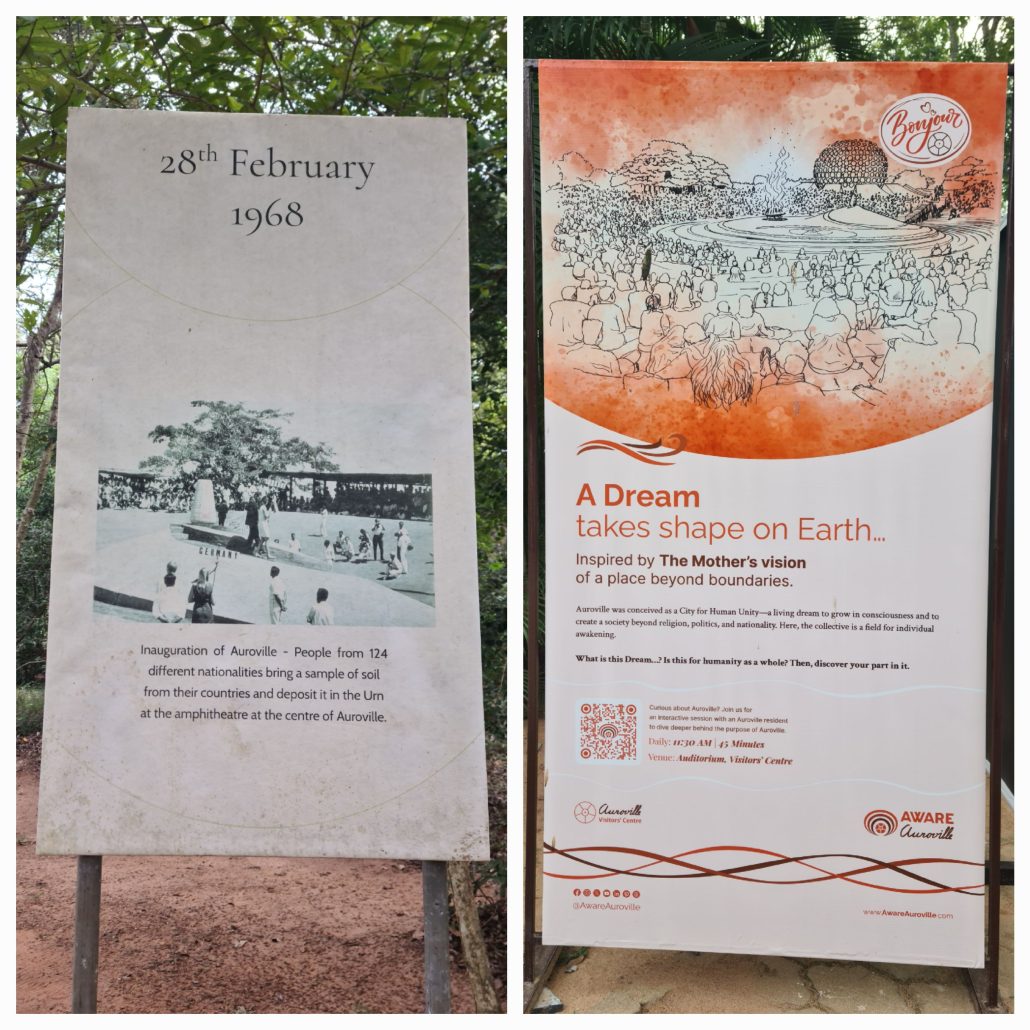
There are daily sessions where residents talk to visitors who are curious about what life is like in Auroville. We were too late, but I did find testimonies that give an insight into why people were drawn to the place.
I assumed, incorrectly, that I’d have no problem finding an oat milk cappuccino in the town or indeed any plant-based alternative to dairy. I also assumed I’d have no problem getting some gluten-free goodies in their famous French bakery.
I was wrong on both counts.
That said, in the adjacent village of Kuilapalayam, when, after half a dozen tries, I did find a coffee shop offering an oat milk cappuccino and a delicious lemon tart, both were the best I’d tried. Anywhere. Ever. And it wasn’t just me. Himself was raving about his cappuccino, too. I’d go so far as to say that if you really like your coffee, Coffee Break is worth a detour.
And while Auroville didn’t grab me, Kuilapalayam has its attractions. I’m still holding out hope for Puducherry, so I might well be back.
Considering I had zero expectations, I’m simply whelmed by Auroville. Not underwhelmed or overwhelmed, just whelmed (and not in the archaic sense, but in the modern sense).
It is an interesting place to visit, and while I found little to entice me to move there, I’d be interested in talking to those who have done so.
While I’ve little interest in changing my faith, I did find a quotation from Sri Aurobindo that resonated:
War is no longer the legitimate child of ambition and earth-hunger, but the bastard offspring of wealth-hunger or commercialism with political ambition as its putative father.

One Response