

I wanted to visit Granville to see the home of designer Christian Dior. Himself was all about the picture-postcard fishing harbour and the cliffs. Neither of us did much more by way of research but we were in Normandy anyway, so why not?
Driving into the town, we started second-guessing our decision. It was a day dampened by the sort of drizzle that sucks motivation from the air as it readies itself for a litany of complaints. We were met by a corridor of retail chains and fast-food outlets – not a fishing boat in sight.
Himself had zero interest in where Dior was born or what he’d gotten up to as a kid but I was there and there was no turning back. We parked up by his birthplace, the very pink Villa Les Rhumbs, now a museum.
I went in to see what I could see.
Himself went exploring.
We met an hour later in the garden café.
He was excited about the possibilities he’d seen on his walk down the hill. I was satisfied that I hadn’t missed much by not being able to afford an original Dior – the Frenchman didn’t design with me in mind.

Old Granville is a walled town built on a rocky outcrop peppered with townhouses and cobblestone streets and salted with boutique shops and cafés. We stopped at the friendly Bar La Rafale for a coffee and availed of the convenience only to find we had to walk through a mirrored wardrobe door to get to it – all very Alice in Wonderlandish.
Haute-Ville was built by the English during the Hundred Years War, on top of high rocks directly on the sea. After the war, the 400 meter long and 200 meter wide Haute-Ville was reinforced by King Charles VII with fortress walls. In the centuries that followed, fishing was Granville’s main source, putting the town in competition with Saint-Malo. […] At the end of the 19th century, a railway line was built from Paris to various places along the coast, including Granville […] nicknamed Monaco of the North.
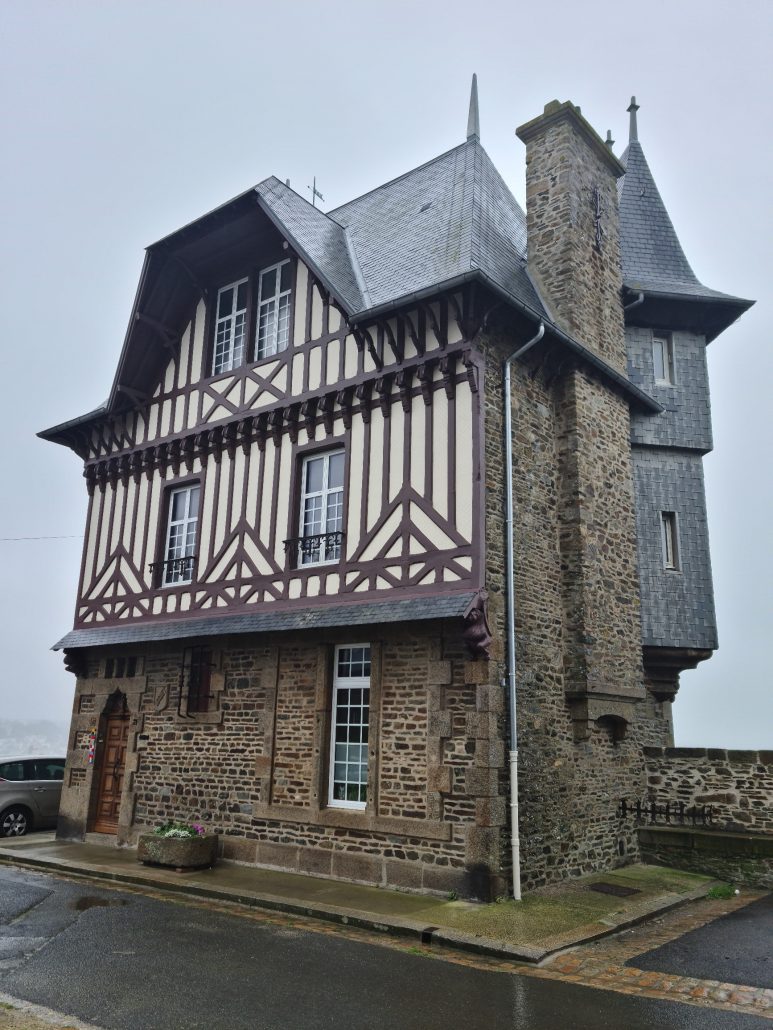
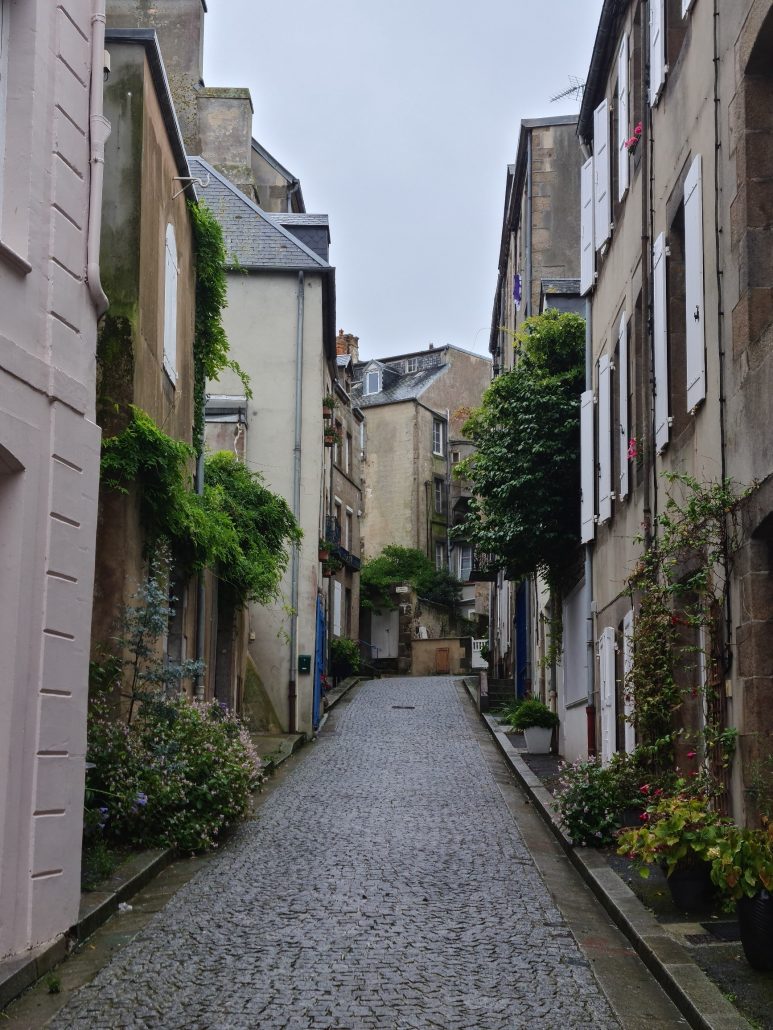

The view across the Bay of Mont Saint-Michel was hazy. From the harbour, boats leave for the Channel Islands and also the 15-km trip to the Chausey Islands. I must have been sick the day we did French geography. I’d never heard of the Chausey Islands or if I had, I quickly forgot.
There are places where time stands still, and Chausey is one of those. In this island paradise, there are no cars, just little cottages connected by rocky paths, and landscapes sculpted by the tides and the Gulf Stream. Chausey is the biggest archipelago in Europe, with 365 islets at low tide and 52 at high tide.
Up by the lighthouse, which sits atop the Roc du Granville, memories of WWII abound. The lighthouse survived and stands tall among the concrete remnants of turrets and bunkers. A copper plaque inscribed in white has quoted messages from Generals Eisenhower and Marshall complimenting the French Resistance. Who knew?

![Bronze plaque with white lettering. Text on the left is in French. Text on the right is in English: Statement by General Eisenhower Commander-in-Chief of the Allied Forces Our staff have estimated that during the French campaign the French Home Forces would have been equivalent of fifteen divisions, the considerable help they gave us by facilitating the speed of our advance, justifies this point of view. Without them (the resistance figthers) the liberation of France and the defeat of the enemy in Western Europe would have been much longer, much more painful and would have cost us many more losses." Letter dated May 31, 1945, from General Eisenhower to General Gubbins, Chief of the Special Operations Executive "in no previous war and no other theater of operations during this war have the Resistance Forces been o [sic] closely integrated into the main military effort. While it is not possible to establish a definitive assessment of the operational value of the action of the resistance, 1 nevertheless consider that the sabotage of enemy railway communications, the harassment of the German columns on the roads, the continuous and increasing pressure exerted on the German war economy and on its internal security services, by organized resistance forces throughout occupied Europe, have played a large part in our complete Victory." Statement by General Marshall, Chief of Staff of the US Armed Forces "The resistance has exceeded all our expectations. It is they who, by delaying the arrival of German reinforcements and by preventing the regrouping of the enemy divisions within France, ensured the success of our raids. Without your troops in the underground, all would have been compromised. The enemy troops moving to Normandy south of the combat zone are systematically harassed by the men of the underground, and with such vigor that it can be said that the German army in France has been caught in the crossfire. More and more, incoming information shows that the organised groups of the resistance are doing everything that was expected of them, and yet more."](https://anyexcusetotravel.com/wp-content/uploads/2023/09/20230831_115228_resized-773x1030.jpg)
The Gothic Cathedral of Notre Dame has its origins in 1113 when, as the story goes, a local fisherman found a statue of Our Lady in his nets. Seen as a sign from heaven, a chapel was built. Some thirty years later, the Parish of Notre Dame was formed.
Fast forward 300 years or so, the English began building the Church of Notre-Dame-du-Cap-Lihou but they’d barely got the foundations in when Charles VII of France dug them up. It would take three centuries to get to where we are today. The bell tower dates from the fifteenth century while the choir, nave, and chapels are mid-1600s, as is the organ. The Louis XIII style façade was added in 1767 and the sacristy in 1771.
After that, it’s situation normal till 1908 when Christian Dior was baptised there. Not that anyone knew then what the future had in store for him, a boy who patterned an illustrious career on making costumes for his mates for the local carnival.
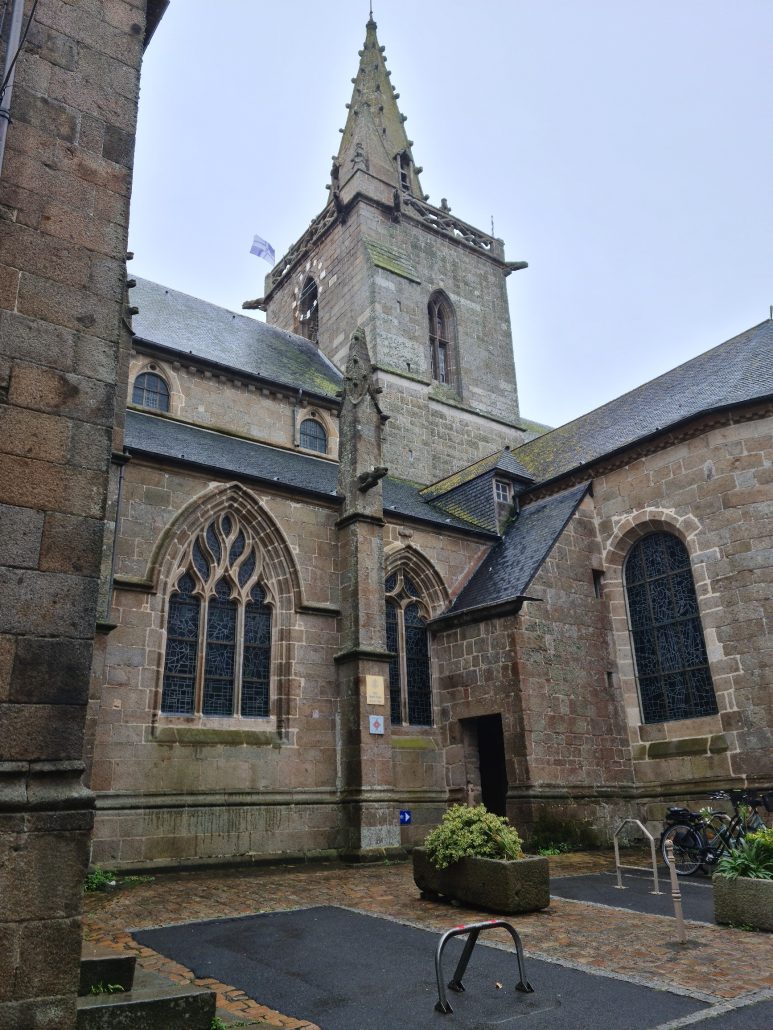
1n 1950, the first Grand Pardon of the Sea took place on the last Sunday of July. And apart from Covid, it’s happened every year since.
Don’t worry, I had to look it up, too.
The Great Pardon of the sea and the corporations is a traditional festival of the Channel, which takes place every year in Granville. This sea festival is traditionally organized on the last Sunday in July, at the initiative of the Association of the Great Pardon of Sea Corporations. It gives rise to a procession in the town center, Cours Jonville, to the port, with banners and models of boats, a mass at the auction, a blessing of the sea and the boats, a lunch, a show and a concert in the Notre-Dame du Cap Lihou church, all ending with a new procession.
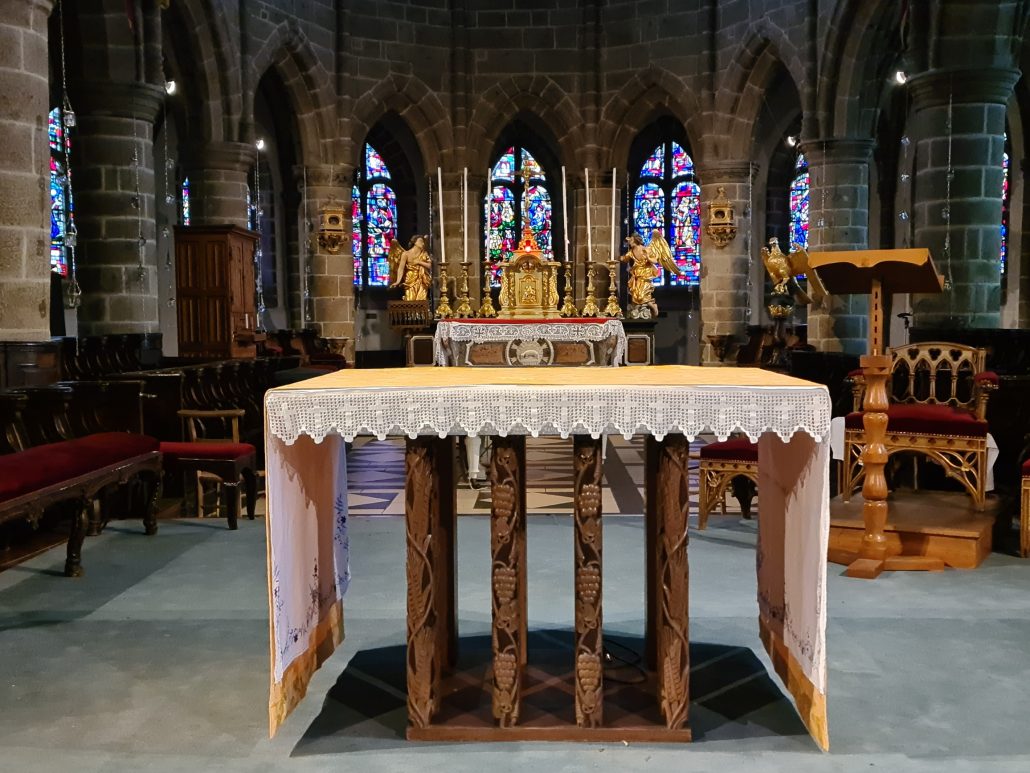
It is a lovely church with interesting art, novel stained glass windows, and unusual stations of the cross.
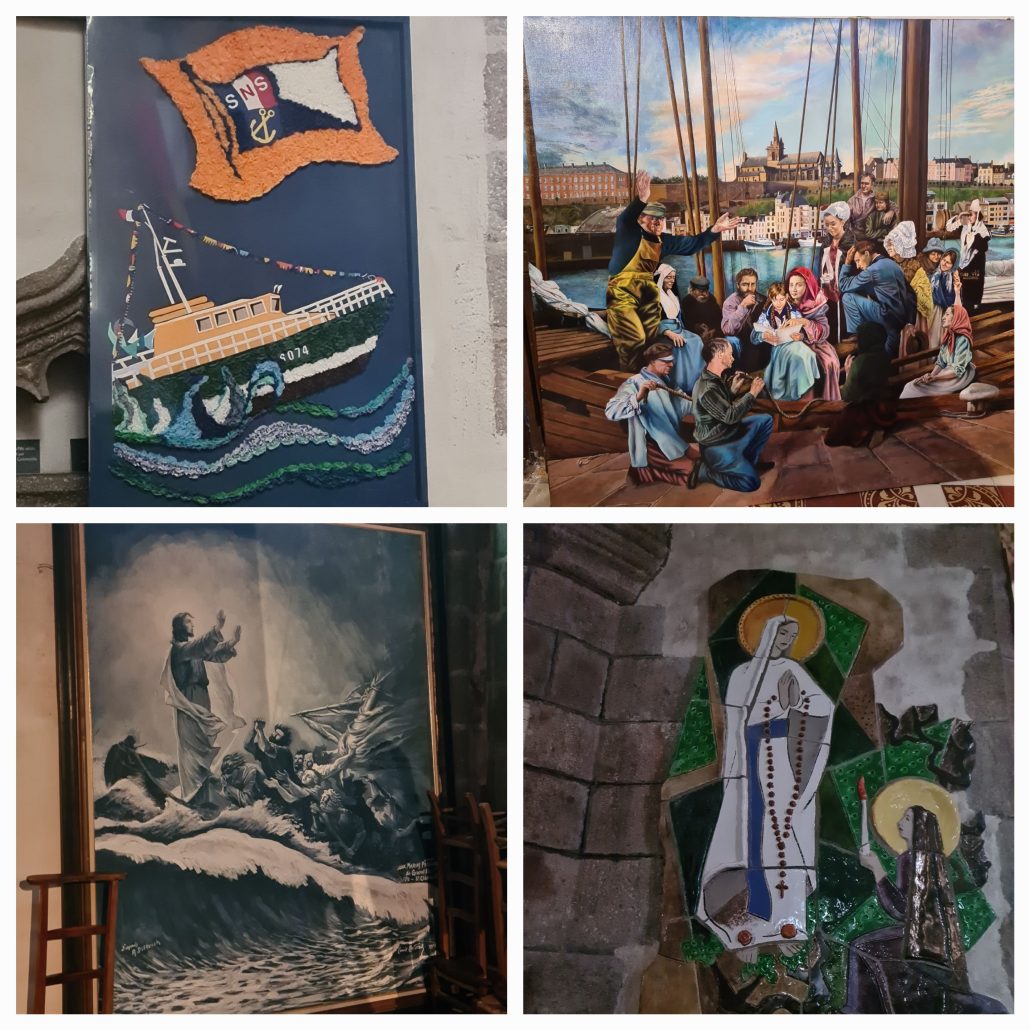


While we were there, a man walked halfway down the centre aisle and turned to face the altar. He stood and sang, history adding to the timbre of his voice. The acoustics were amazing. My view of the altar was partially hidden so when a choir of 8 or 10 people, standing in a semi-circle facing him with their backs to the altar (I had to look) answered him, I got an unexpected treat. We surmised they were a visiting choral group trying the church on for size.

As we drove out of the town, passing by the harbour, we were happy with our detour, despite the dreary weather. We hugged the coast hoping to get a glimpse of Mont Saint Michel. Short on time – we had a dear friend we wanted to spend time with – we left the walk out to the island monastery for another day, off-season, when it’s not so busy.

We stopped off to buy some of the local speciality – salted butter caramels (I’m not a fan but each to their own and all that) – and when in the shop, himself found a delightful cookbook for me. The publisher’s blurb goes like this:
The sisters of the most famous abbey in the world open their doors for an exceptional invitation to their table. A collection of simple, easy-to-make recipes presenting dishes respecful of the seasons, this book highlights a way of life based on sharing and offers a moment of indulgence in this sublime and fascinating place that is the Mont-Saint-Michel. With the complicity of the sisters, another Mont reveals itself during a year of everyday moments and shared meals.
I’m savouring the read.
Notes for next time…if there is a next time
- Visit the Roc des Harmonies aquarium
- Try out one of the thalassotherapy spas
- Consider learning to sail at The Centre Régional de Nautisme
PS – check this lovely photo of the haute-ville from the water

2 responses