

Visiting Malta for the umpteenth time with Air Malta and looking forward to seeing more of what the islands had to offer, Roman beehives weren’t high up my list. I was more than surprised when we happened on a series of Roman apiaries at Xemxija, dating back to about 1000 AD. My dad keeps bees. I have a vague idea of how it all works. I saw Bee movie. But nothing I’ve seen or read prepared me for these apiaries and once again since I first started coming to Malta, I found myself marvelling at how clever those Romans were…

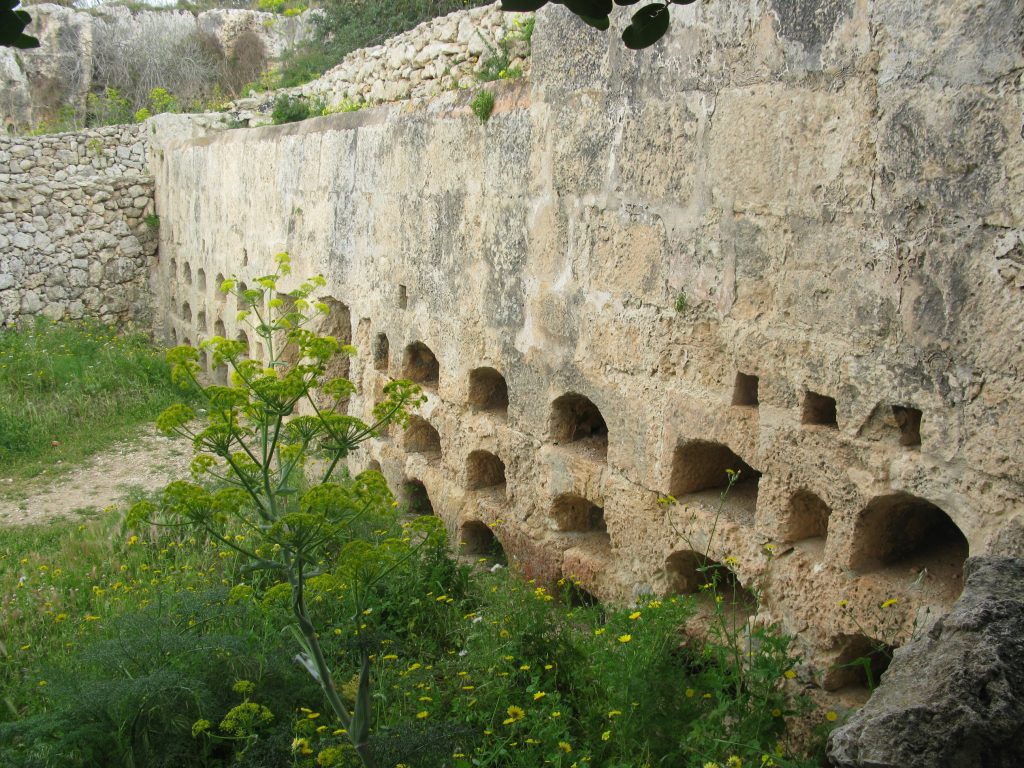
The ‘hives’ are pottery cannisters secured behind the open slots in the apiary. The hives had a small hole to the outside, which the bees used, and a larger one to the passage inside the cave which was blocked with a tile until the beekeeper removed the honeycomb. Amazing stuff when you think about it.

The Maltese honey bee, Apis mellifera ruttneri, is a sub-species of the Western honey bee and is native to Malta. The name ‘Malta’ is most likely derived from either the Greek or Roman word for honey. And a working bee may have to visit as many as 500 flowers in order to produce just a single teaspoon of honey. A lot of work for very little return. Just as well those boys are not paid by the hour. I’m not much into honey myself but I have it on good authority that Maltese honey is amongst the finest there is. It’s got something to do with the abundance of wild thyme, clover and carob.

Interestingly, after watching the Irish Sci Fi 100 mornings last weekend and musing to my companion that were I to be stranded and left to forage for food from the land, I’d be damned picky about who I was stranded with, I ate my fill on this trek to the apiaries – wild beans, peas, and asparagus. The carob I could have done without.

2 responses
Hallo, Mary Murphy, I see this page was put up in 2012, so I hope you are still reading comments. I would very much like to use your lovely photo of the Roman beehives as a black and white chapter heading in my latest novel which is set in 1st Century AD partially on Malta. Please email me if you would like more details. Full acknowledgement will be given, of course. The book is due to go to print before Christmas 2024.
Thank you.
S.J. Knight
Susan – am so sorry that I’m only now seeing this – of course you can use it